Table of Contents
- Why It Matters to Know Vietnam's Crops
- Types of Grains and Staple Crops
- Types of Vegetables
- Types of Fruit
- Types of Nuts and Legumes
- Types of Industrial Crops and Stimulant Crops
- Types of Spices and Herbs
- Regional Map of Vietnam's Crops
- Frequently asked questions
- Summary
Why It Matters to Know Vietnam's Crops
Vietnam is one of Southeast Asia's leading agricultural power. Its territory, stretching roughly 1,650 km from north to south, lies in a tropical and subtropical climate, where a wide variety of crops are grown. So, specifically, which crops are grown in which regions?
Vietnam's agriculture accounts for about 12% of GDP (2023, General Statistics Office of Vietnam) and is a key industry employing about 30% of the workforce. Rice export volume ranks third in the world, and coffee production ranks second, after Brazil.
This article classifies the crops grown in Vietnam into six genres, grains, vegetables, fruit, nuts and legumes, industrial crops, and spices and herbs, and introduces them comprehensively like an illustrated guide. We have prepared a table for each genre, so please bookmark it and put it to use.
Types of Grains and Staple Crops
The grains that sustain the Vietnamese table form the backbone of the national economy and food security. In particular, the Mekong Delta (the large river-delta region spreading southwest of Ho Chi Minh City in southern Vietnam) and the Red River Delta (the plains around Hanoi in northern Vietnam) are the two great granaries.
| Items | Main Growing Regions | Annual Production (Approximate) | Characteristics |
|---|---|---|---|
| Rice (paddy) | the Mekong Delta, the Red River Delta | About 43 million tonnes | Double cropping, and up to triple cropping is possible. Many varieties, such as jasmine rice and glutinous rice |
| Maize | the Central Highlands, the northeastern mountains | About 4.6 million tonnes | Mainly for feed, but sweet varieties are also popular for food |
| Sweet potato | the central coast, the north | About 1.3 million tonnes | Purple-fleshed varieties are a distinctive Vietnamese specialty |
| Cassava | the Central Highlands, the southeast | About 10 million tonnes | Also grown for export as a starch raw material |
| Potato | the northern highlands (including the area around Da Lat) | About 350,000 tonnes | Grown in cool highlands, for domestic demand |
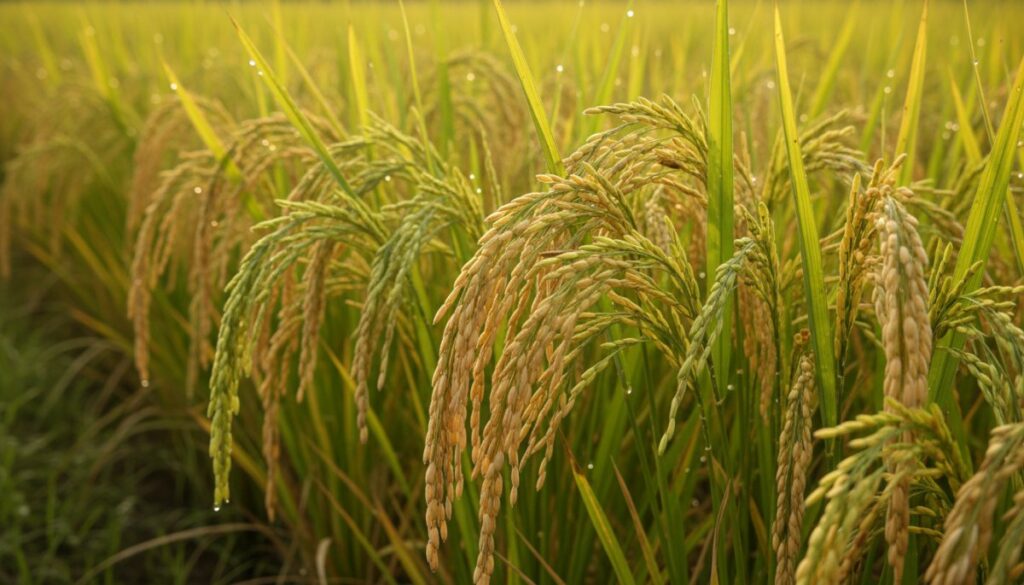
Rice is especially important, with annual per-capita consumption in Vietnam reaching about 150 kg. The Mekong Delta alone accounts for about 50% of national production, and the high-quality export rice ST25 has at times received top honors in international contests.
Types of Vegetables
Making the most of its warm climate, Vietnam produces a rich variety of vegetables year-round. Da Lat in the Central Highlands (Lam Dong Province, a highland city at about 1,500 m elevation) is known as the "Vietnam vegetable capital," so much so that it is a major producer of leafy and root vegetables.
Leafy and Stem Vegetables
| Items | Vietnamese name | Main origins | Notes |
|---|---|---|---|
| Water spinach (rau muong) | Rau muống | Nationwide | A Vietnamese staple. Used in stir-fries and soups |
| Bok choy | Cải thìa | the north, Da Lat | An ingredient for hot pots and soups |
| Mustard greens | Cải bẹ xanh | Nationwide | Also important as a raw material for pickles (dua cai) |
| Various lettuces | Xà lách | Da Lat | Demand for eating raw is increasing |
| Molokhia | Rau đay | North | A traditional soup ingredient |
| Malabar spinach | Mồng tơi | Nationwide | A representative summer leafy vegetable |
Fruiting and Root Vegetables
| Items | Vietnamese name | Main origins | Notes |
|---|---|---|---|
| Tomato | Cà chua | Da Lat, the north | About 700,000 tonnes produced annually |
| Cucumber | Dưa chuột | Nationwide | Widely used raw and in pickles |
| Eggplant | Cà tím | the south, the center | Has distinctive varieties such as white eggplant and round eggplant |
| Luffa | Mướp | South | An ingredient for soups and stir-fries |
| Bitter melon | Khổ qua | Nationwide | A soup stuffed with meat is a classic dish |
| Daikon radish | Củ cải trắng | the north, Da Lat | Used in simmered dishes and pickles |
| Carrot | Cà rốt | Da Lat | Good quality from highland cultivation |
| Onion | Hành tây | Da Lat, the north | Domestic demand is trending upward |
Cautions: Vietnam vegetable Even for the same item, varieties differ greatly by region in the markets. For example, in the south small round eggplants are the norm, while in the north long eggplants similar to those in Japan are common.
Types of Fruit
Vietnam is a treasure trove of tropical fruit. Centered on the Mekong Delta, the south harvests abundant fruit year-round. Fruit export value in 2023 reached about US$5.5 billion (General Department of Vietnam Customs), with exports to China, the US, and the EU expanding rapidly.
Tropical Fruit
| Items | Vietnamese name | Main origins | Peak Season |
|---|---|---|---|
| Durian | Sầu riêng | the Central Highlands, the southeast | May to August |
| Mango | Xoài | the south (such as Khanh Hoa Province) | April to July |
| Dragon fruit | Thanh long | Binh Thuan Province, Long An Province | Year-round |
| Rambutan | Chôm chôm | the southeast, the Mekong Delta | May-September |
| Mangosteen | Măng cụt | the southeast | May to July |
| Jackfruit | Mít | nationwide (mainly the south) | Year-round |
| Papaya | Đu đủ | Nationwide | Year-round |
| Coconut | Dừa | Ben Tre Province, the Mekong Delta | Year-round |
| Passion fruit | Chanh dây | the Central Highlands (Gia Lai Province) | Year-round |
| Guava | Ổi | Nationwide | Year-round |
| Star fruit | Khế | South | Year-round |
| Sapodilla | Hồng xiêm | the south, the north | September-December |
Citrus and Temperate Fruit
| Items | Vietnamese name | Main origins | Peak Season |
|---|---|---|---|
| Pomelo | Bưởi | Binh Duong Province, Ben Tre Province | August-December |
| Orange | Cam | Vinh Long Province, Ha Giang Province | October to February |
| Lychee | Vải | Bac Giang Province, Hai Duong Province | June to July |
| Longan | Nhãn | Hung Yen Province, the south | July to September |
| Persimmon | Hồng | Da Lat, the northern mountains | October to December |
| Strawberry | Dâu tây | Da Lat, Moc Chau | November to March |
Common Pitfall: Quality standards (such as VietGAP certification) for export fruit like durian and dragon fruit are tightening year by year. When considering importing or trading Vietnamese fruit, it is important to check the latest certification schemes.
Types of Nuts and Legumes
Vietnam's nuts and legumes hold an important place not only in domestic consumption but also as raw materials for processed foods. Cashew nuts ranks first in the world for processing and export volume (2023, Vietnam Cashew nuts Association).
| Items | Vietnamese name | Main origins | Characteristics |
|---|---|---|---|
| Cashew nuts | Hạt điều | Binh Phuoc Province, the southeast | World's top processed-export volume. Raw material is also imported from Africa |
| Peanut (groundnut) | Đậu phộng / Lạc | the center, the north | About 400,000 tonnes produced annually. For snacks and as an oil raw material |
| Soybean | Đậu nành | the northern mountains | Raw material for tofu and soy sauce. Domestic production is declining |
| Mung bean | Đậu xanh | Nationwide | An ingredient for che (sweet desserts) and banh |
| Adzuki bean | Đậu đỏ | North | Used in sweet bean paste and confections |
| Macadamia nut | Mắc ca | the Central Highlands (Dak Lak Province) | Cultivation began in the 2000s. An emerging high-value crop |
Cautions: Vietnam's cashew industry mainly follows a business model of importing raw nuts from abroad (chiefly African countries) and processing and exporting them domestically. Note that the volume of raw nuts grown domestically differs greatly from the processed-export volume.
Types of Industrial Crops and Stimulant Crops
Industrial crops are crops grown on the premise of being processed. Vietnam is also a major producer of stimulant products and seasonings such as coffee and pepper.
| Items | Vietnamese name | Main origins | World Rank |
|---|---|---|---|
| Coffee (Robusta mainly) | Cà phê | the Central Highlands (Dak Lak Province, Lam Dong Province) | Production: 2nd in the world |
| Pepper | Tiêu | Binh Phuoc Province, Phu Quoc Island | Export volume: 1st in the world |
| Tea | Chè / Trà | the northern mountains (Thai Nguyen Province), Lam Dong Province | Production: 7th in the world |
| Natural rubber | Cao su | the southeast, the Central Highlands | Production: 3rd in the world |
| Sugarcane | Mía | the center, the south | Supplies about half of domestic sugar demand |
| Tobacco | Thuốc lá | the north, the Central Highlands | Grown by making use of the cool highland climate |
Coffee in particular boasts about 600,000 hectares of cultivated area, centered on Dak Lak Province in the Central Highlands (called the "capital of Vietnamese coffee"). In recent years, a shift to high-quality Arabica has also been advancing, and its presence in the specialty coffee market is growing.
Types of Spices and Herbs
Spices and herbs, indispensable to Vietnamese cuisine, are also an important crop category. Fresh herbs are said to be the "soul of Vietnamese cooking," and the fresh herbs served with pho and banh mi are a symbol of the food culture.
| Items | Vietnamese name | Uses and Features |
|---|---|---|
| Basil (que) | Húng quế | A condiment for pho. A variety close to Thai basil |
| Coriander (cilantro) | Rau mùi | Widely used in northern cooking. Also called "ngo ri" in the south |
| Lemongrass | Sả | Used to scent meat dishes, and in herbal teas |
| Fish mint | Diếp cá | A side for banh xeo. A distinctive flavor |
| Perilla | Tía tô | Essential to the northern rolled dish (nem) |
| Garlic | Tỏi | Those from Ly Son Island (off Quang Ngai Province) are the finest |
| Ginger | Gừng | A condiment and used in traditional medicine. Grown nationwide year-round |
| Turmeric | Nghệ | A health food and seasoning. The Central Highlands is the main growing region |
| Cinnamon (cassia) | Quế | Yen Bai Province is a noted producer. Used in essential oils and traditional medicine |
| Star anise | Hồi | Lang Son Province is one of the world's leading producers. Used to scent pho |
Regional Map of Vietnam's Crops
Because Vietnam's territory is long from north to south, the climate differs by region, and there are large differences in the crops grown. Below we summarize the main crops by region.
The North (the Red River Delta and the mountains)
- Main crops: rice (single to double cropping), tea, lychee, star anise, cinnamon
- Climate Features: Has four seasons. Winter can drop below 10 C
- Representative Provinces: Thai Nguyen Province, Bac Giang Province, Ha Giang Province
The Center (the coast and the highlands)
- Main crops: coffee, pepper, macadamia nuts, vegetables (Da Lat), passion fruit
- Climate Features: The highlands are cool. The coast is prone to typhoons
- Representative Provinces: Dak Lak Province, Lam Dong Province, Gia Lai Province
The South (the Mekong Delta and the southeast)
- Main crops: rice (triple cropping), dragon fruit, durian, coconut, cashew nuts
- Climate Features: Hot year-round. Clear rainy and dry seasons
- Representative Provinces: An Giang Province, Dong Thap Province, Binh Thuan Province
Understanding each region's strengths in this way lets you grasp Vietnam's crops systematically.
Frequently asked questions
Q1. What is the highest-volume crop in Vietnam?
Rice (paddy) is the largest, with annual production of about 43 million tonnes. It is followed by cassava (about 10 million tonnes) and maize (about 4.6 million tonnes).
Q2. Where does Vietnam's coffee rank in the world?
Vietnam is the world's second-largest coffee producer, after Brazil. It mainly grows Robusta, which is exported worldwide for instant coffee and for blends.
Q3. Which Vietnamese fruits are imported into Japan?
Dragon fruit, mango, lychee, and pomelo are imported into Japan. In 2023, durian exports to Japan also began to pick up in earnest. However, because of plant-quarantine regulations, not all fruit can be imported.
Q4. When is the peak season for Vietnamese crops?
The south has many crops that can be harvested year-round, while the north is affected by the seasons. The representative peak seasons are June to July for lychee, May to August for durian, and August to December for pomelo. Rice is harvested two to three times a year depending on the region.
Q5. Is organic farming advancing in Vietnam?
VietGAP (Vietnam's version of good agricultural practice) certification is spreading, and the area under organic farming is also expanding year by year. As of 2023, about 240,000 hectares have obtained organic certification (Ministry of Agriculture and Rural Development). However, the share of total farmland remains only around 2%.
Q6. Is it true that Vietnam is first in the world for cashew processing and export?
Yes. In 2023, Vietnam exported about US$3.5 billion worth of cashew nuts. However, about half of the raw material is imported from African countries, so note that it is not the world's top producer on domestically grown volume alone.
Summary
Vietnam's crops span a truly wide range of genres: grains, vegetables, fruit, nuts, industrial crops, and spices. The climatic diversity created by the 1,650 km stretch of territory from north to south is the source of this agricultural richness.
Organizing what this article has introduced, the following points emerge.
- Rice, coffee, pepper, and cashew nuts have world-class production and export volumes
- Mekong Delta has grains and fruit; Central Highlands has coffee and nuts; North is strong in tea and lychee
- Durian and dragon fruit and other fruit export values are growing rapidly
- VietGAP certification and a shift to organic farming is under way
Vietnam's agriculture is right now in a transition period from quantity to quality. We hope this article deepens your understanding of Vietnam's crops and serves as a reference for business or research. If any item caught your interest, please also see the detailed articles for each genre.