The Structural Challenges Facing Vietnamese Agriculture
Vietnam is one of Southeast Asia's leading agricultural countries, with a population of about 100 million.
The share of agriculture, forestry, and fisheries in GDP is around 12%, but on an employment basis about 30% are still engaged in agriculture-related work, so even now, with industrialization advanced, agriculture can be said to be the very foundation of society.
The 1986 Doi Moi policy Since the economic opening brought about by it, productivity rose sharply through the individual allocation of land-use rights and the introduction of a market economy, and since the 1990s, as a rice export exporting country it has entered the world's top ranks. Coffee boasts the world's second-largest export volume, and pepper, Cashew nuts seafood, and other items have grown into major export products.
However, behind this spectacular growth lurk serious structural challenges.
The Inefficiency Brought by a Small-Scale-Farm Structure
The biggest feature of Vietnamese agriculture is its extremely small-scale-farm structure.
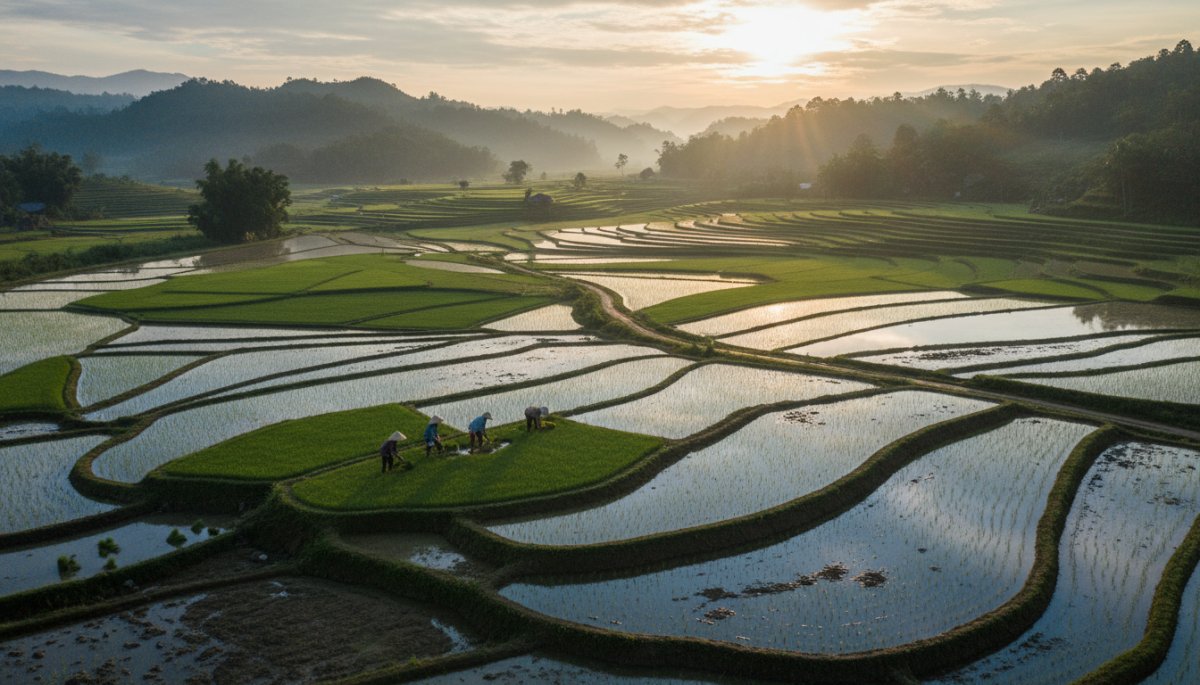
The average cultivated area is mostly under 1 ha, and many farmers hold only about 0.3 to 0.5 ha. At this scale, investment in mechanization is difficult, quality varies widely, and the structure makes standardization and price negotiation difficult.
A Price-Setting Structure Dependent on Middlemen
Because smallholders are scattered, collectors (brokers) hold the power to set prices, and farmers have almost no bargaining power.
Organized consolidation like Japan's agricultural-cooperative model is weak, and the structure makes it hard for farm incomes to rise. It is difficult for individual farmers to face the market on their own, and as a result dependence on middlemen rises, with most of the profit being absorbed at the distribution stage.
Underdeveloped Processing Infrastructure
Secondary processing such as drying, milling, and extraction is still developing.
As a result, large quantities of off-spec produce and surplus crops are generated. Rice, coffee, pepper, seafood, and more are mostly exported as raw materials or in a lightly processed state, and the reality is that in many cases the added value is captured on the overseas side.
This situation of being "stuck at primary products" has become a major wall blocking the raising incomes of farmers.
Source
Foundation for International Development/Relief (FIDR), "Agriculture in Southeast and South Asia"
prepared from
Crop Differentiation by Region and Environmental Challenges
Vietnamese agriculture shows clear crop differentiation by region.
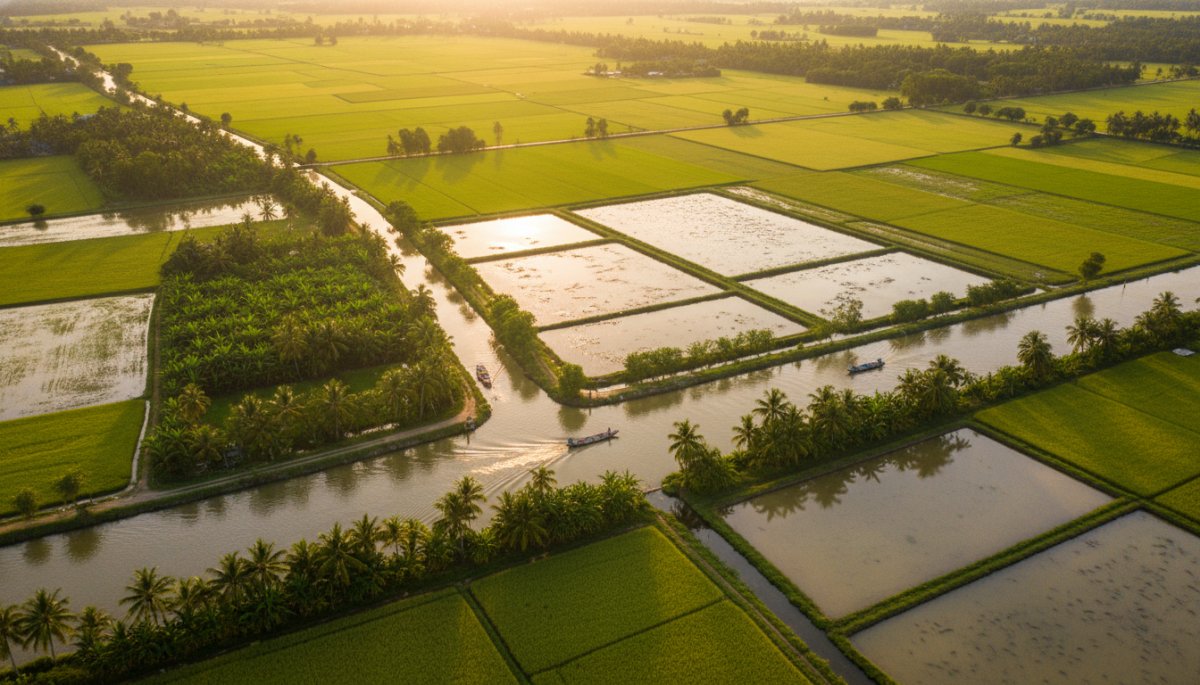
The Mekong Delta: The Country's Largest Granary
The southern Mekong Delta accounts for about half of Vietnam's rice production and nearly 90% of its export rice.
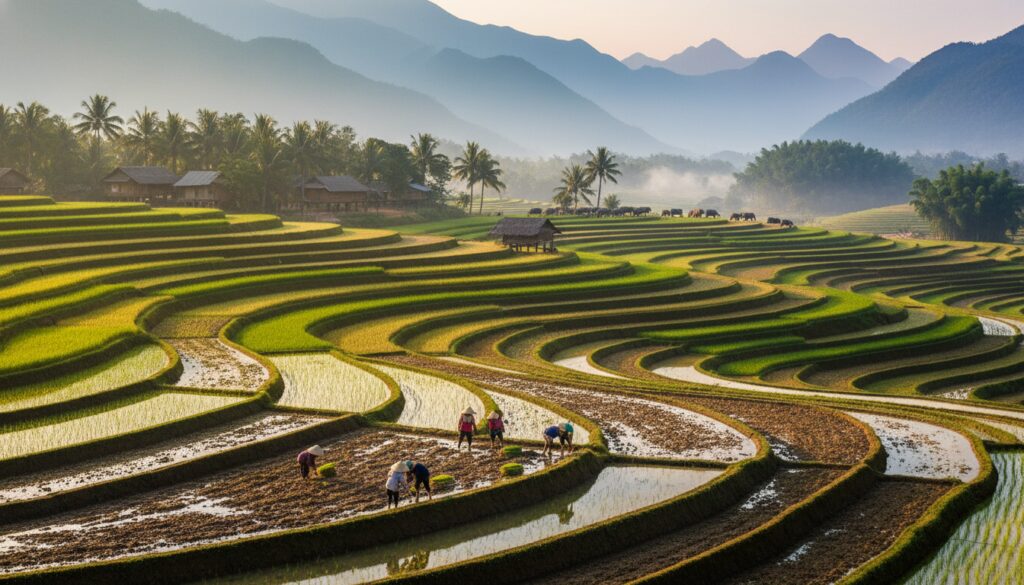
Thanks to the alluvial soil and abundant water of the Mekong River, two to three crops a year are possible, and it boasts some of the highest land productivity in the world. In addition to rice, there are tropical fruit trees such as coconut, mango, and dragon fruit, as well as freshwater fish and shrimp farming are also flourishing.
However, in recent years, due to the effects of salt damage, single-crop rice cultivation has become difficult, and mixed operations such as "rice plus shrimp" and "conversion to fruit trees" are increasing.
The Worsening of Salt Damage and Structural Change
Salt damage in the Mekong Delta is worsening.
Due to sea-level rise and the effects of upstream dams, in the dry season saltwater runs up inland, and the area where rice cultivation is impossible is increasing. As a result, structural changes such as switching to salt-tolerant varieties, conversion to fruit trees, conversion to aquaculture, and expanding reliance on groundwater are progressing.
This environmental change is forcing farmers to acquire new techniques and make new investments, and cases where farmers unable to cope are compelled to leave farming are also increasing.
The Central Highlands: The Core Region for Export Crops
The Central Highlands (such as Dak Lak Province) is the main producing area for coffee, black pepper, and cashew nuts.
The volcanic soil and the climate conditions at 500 to 800 m elevation suit these crops. However, reliance on single crops is strong, and it also carries a vulnerability to being directly affected by international prices and drought.
The Northern Red River Delta: Peri-Urban Agriculture
This is a peri-urban farming belt that includes the capital, Hanoi, centered on intensive cultivation of leafy vegetables and fruiting vegetables in addition to rice.
Here the feature is a higher ratio geared to domestic consumption than to export. In peri-urban villages that have faced farmland expropriation for industrial-park development, with the growth of employment in other industries, centered on young labor as the local labor market develops, the standing of farm income in the farm economy has fallen greatly, and there is a tendency for departure from agriculture to be noticeably progressing.
Source
J-Stage, "Changes in Rice-Farming Structure and Farm Economy in Vietnam During Its Industrialization Period"
Compiled from (April 2022)
Aquaculture: Another National Strategic Industry
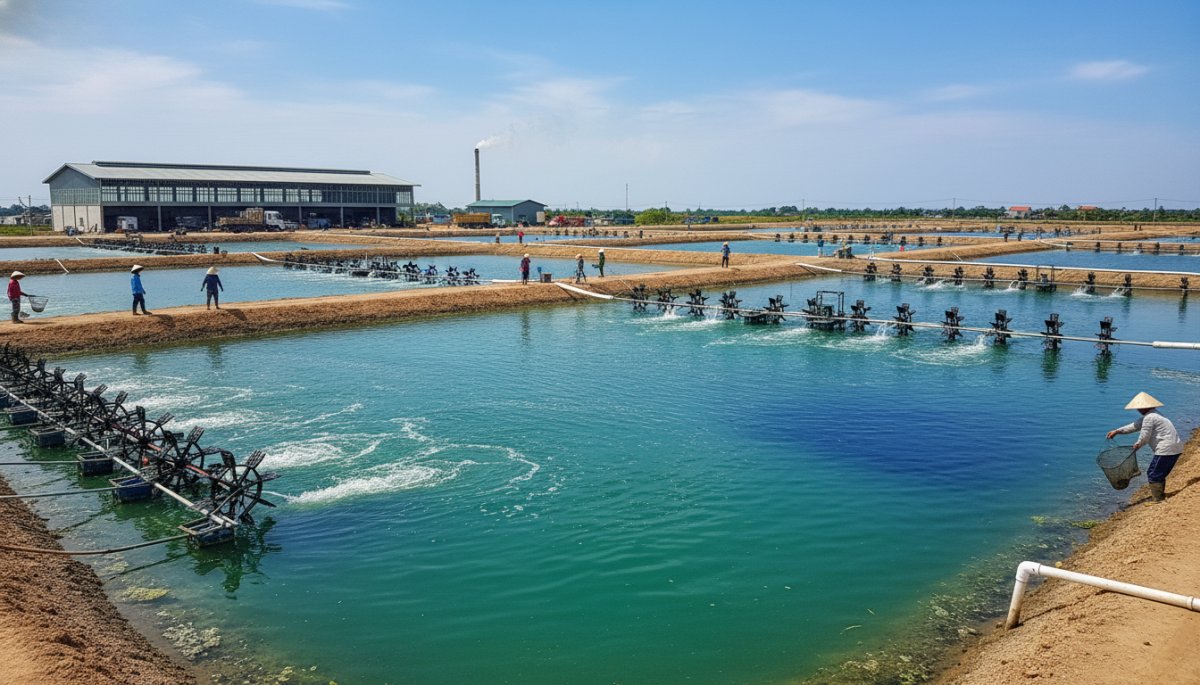
The national strategic industry that stands alongside agriculture is aquaculture.
In the Mekong Delta, shrimp farming and pangasius (catfish) farming are carried out on a large scale, forming a pillar of exports to Japan, the EU, and the United States. A value chain linked to frozen-processing plants has been built, and a model of earning foreign currency through "production plus simple processing" has been established.
In this field, obtaining international certifications, managing residual chemicals, and handling traceability are advancing, and moves to respond to tightening regulations in export destinations can be seen.
Practical Solutions: International Certification and Smart Agriculture
Practical solutions to the structural challenges are being explored.
Promoting GlobalG.A.P. Certification
Against a backdrop of tighter regulations in importing countries, the acquisition of international certifications such as GlobalG.A.P. is advancing.
Through this, residual-pesticide management and traceability handling are strengthened, and competitiveness in international markets improves. Although obtaining certification is a heavy burden for small-scale farmers, through the formation of cooperatives and group-certification schemes, its spread is gradually advancing.
The Adoption of Smart Agriculture
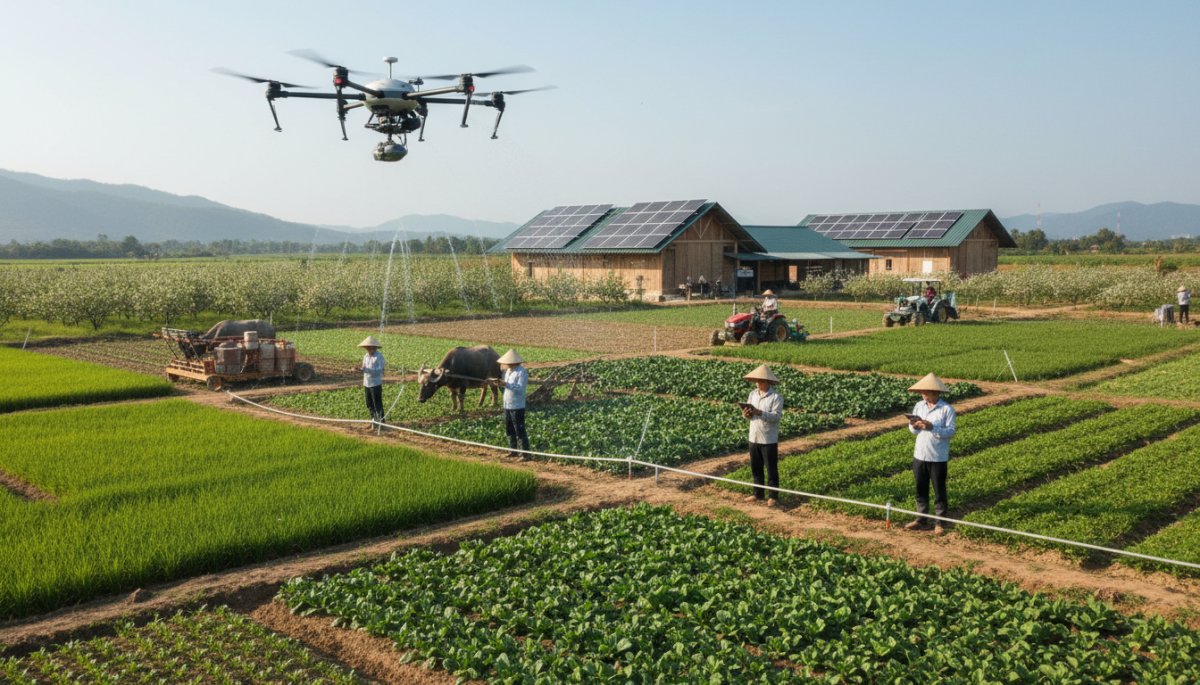
The introduction of smart agriculture, such as drone-based pest control and IoT irrigation, has also begun at some large farms.
However, its spread is limited, and the vast majority of small-scale farmers still practice labor-intensive farming. Technology adoption requires initial investment, and it is difficult for small-scale farmers to adopt it on their own. For this reason, cooperatives and tie-up models with companies are becoming important.
The Farmer-Factory-Distribution Linkage Model
Based on Decree No. 98/2018/ND-CP, a three-way linkage model connecting farmers, processing factories, and the distribution system is being promoted.
This model serves as a solution to major challenges such as small-scale production, quality variation, and supply-demand imbalance. As of the end of June 2025, this agricultural value chain has recorded the achievement of approving a total of 2,938 projects and linkage plans, including 1,968 projects and 970 linkage plans.
From an economic standpoint, this decree offers a strong financial incentive by providing 30% of the investment capital, up to a cap of 10 billion dong per project, for infrastructure-development projects such as machinery and equipment, factories, warehouses, and processing facilities.
Source
B&Company, "The Farmer-Factory-Distribution Linkage Model in Vietnam: Current State and Potential for Development"
prepared from
Consolidation and Stronger Bargaining Power Through Cooperatives
The key to overcoming the challenges of small-scale farmers is forming cooperatives.
In the current situation where individual farmers are dispersed, both price-bargaining power and quality management are difficult. By consolidating production through cooperatives, buying inputs jointly, and shipping jointly, dependence on middlemen can be lowered and farmers' take-home earnings can be increased.
Concrete Benefits of Forming Cooperatives
Through forming cooperatives, the following benefits can be expected.
- Reduced input costs through joint purchasing
- Improved price-bargaining power through joint shipping
- Improved market reputation through unified quality management
- Cost reduction through group acquisition of international certification
- More efficient technical guidance and information sharing
However, running a cooperative requires specialized knowledge and experience, and developing leadership and accumulating organizational-management know-how are challenges.
The Potential for Japanese Companies
The current state of Vietnamese agriculture holds great potential for Japanese companies.
Strong raw-material supply capacity
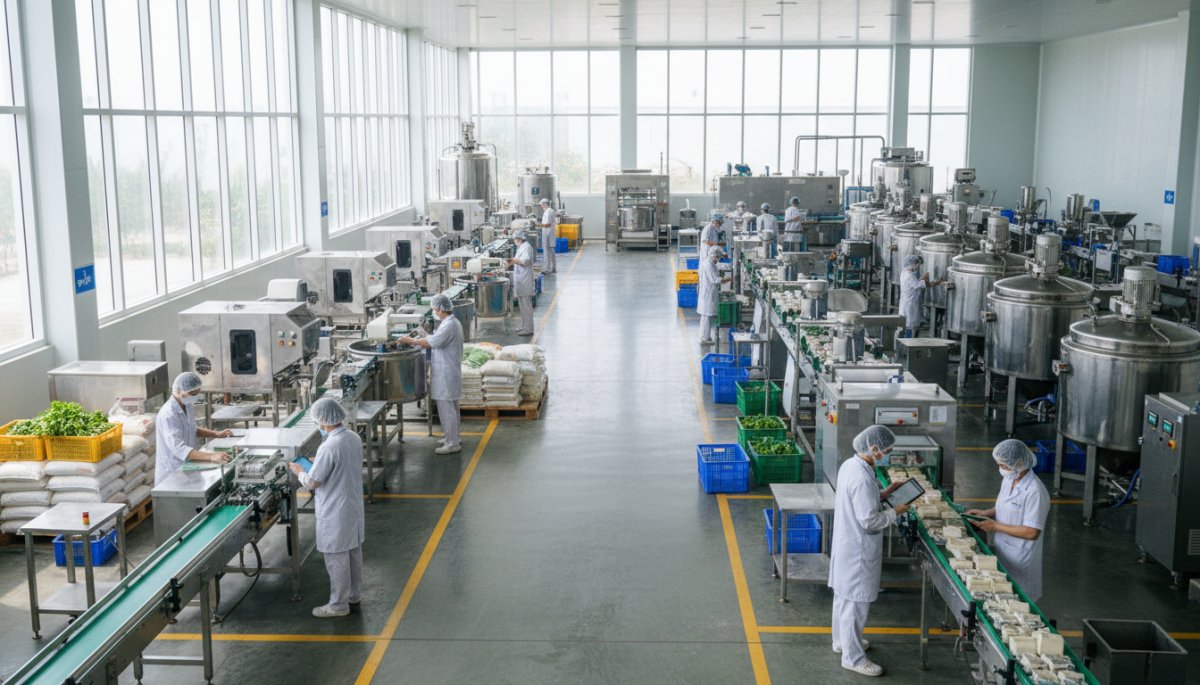
It is characterized by strong raw-material supply capacity in fruit, coffee, spices, and the like, weak processing stages, large room for drying, grinding, and conversion into raw materials, and the existence of large quantities of off-spec produce.
The current situation of being "stuck at primary products" is a structure that fits very well with the Japanese-style processing and high-value-added model. There is still large room for development into dried vegetables, fruit powders, extract ingredients, functional raw materials, and more.
Technology transfer and workforce development
By transferring Japanese processing technology and quality-management know-how, one can contribute to raising the added value of Vietnamese agriculture.
At the same time, through local human-resource development, it is possible to build a sustainable business model. As with Ajinomoto Vietnam, efforts that achieve both productivity improvement and reduced GHG emissions, such as a regenerative-agriculture demonstration project in cassava cultivation, are also advancing.
Source
Ministry of Economy, Trade and Industry, "FY2024 Supplementary Global South Future-Oriented Co-Creation Project Subsidy"
prepared from
Summary: A Path to Sustainable Development
Vietnamese agriculture faces a complex set of challenges: a small-scale-farm structure, dependence on middlemen, a lack of processing infrastructure, and environmental change.
However, these challenges are at the same time great potential. Practical solutions, such as obtaining international certification, introducing smart agriculture, forming cooperatives, and the farmer-factory-distribution linkage model, are steadily making progress.
For Japanese companies, the strong raw-material supply capacity and the weak processing stages become an opportunity for technology transfer and higher added value. Many fields remain undeveloped, such as dried vegetables, fruit powders, extract ingredients, and functional raw materials.
Whether Vietnamese agriculture can evolve from a "raw-material supplier" into an "agricultural nation with processing and brands" is the biggest fork in the road ahead.
Addressing the challenges that small-scale farmers face is not merely the solving of an agricultural problem; it is directly connected to the sustainable development of Vietnamese society as a whole. Consolidation through cooperatives, quality improvement through international certification, efficiency through smart agriculture, and higher added value through collaboration with Japanese companies. As these efforts link together organically, Vietnamese agriculture will evolve to a new stage.
Won't you help create the future of Vietnamese agriculture together with us?
VN AGRI supports the solving of Vietnamese agriculture's challenges and its sustainable development. From small-scale farmers'raising incomes, the introduction of environmentally conscious farming technology, and strengthening competitiveness in international markets, we provide solutions tailored to a wide range of needs. Companies considering investment or technical cooperation in Vietnamese agriculture, and those considering local business development, please feel free to contact us.