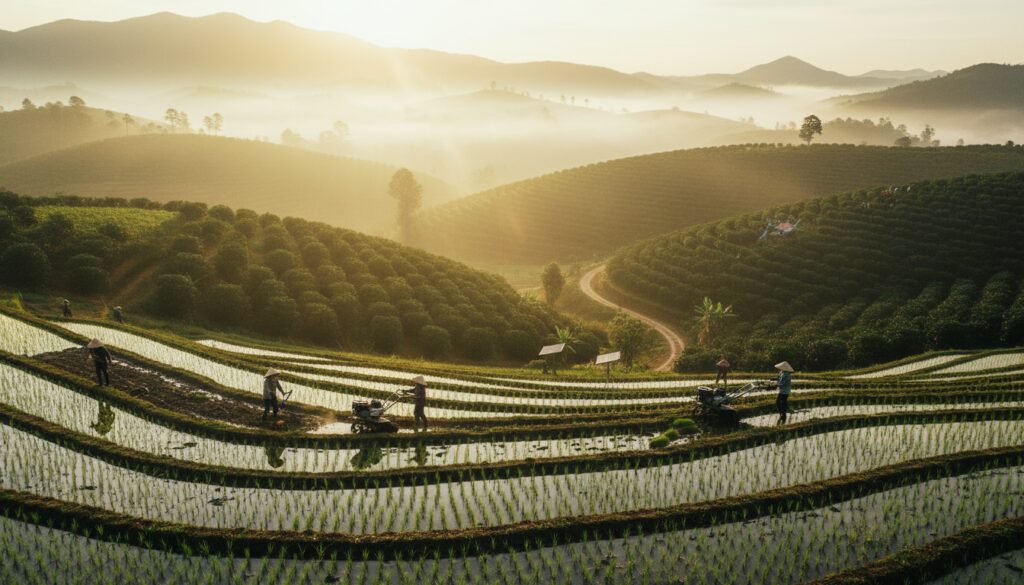
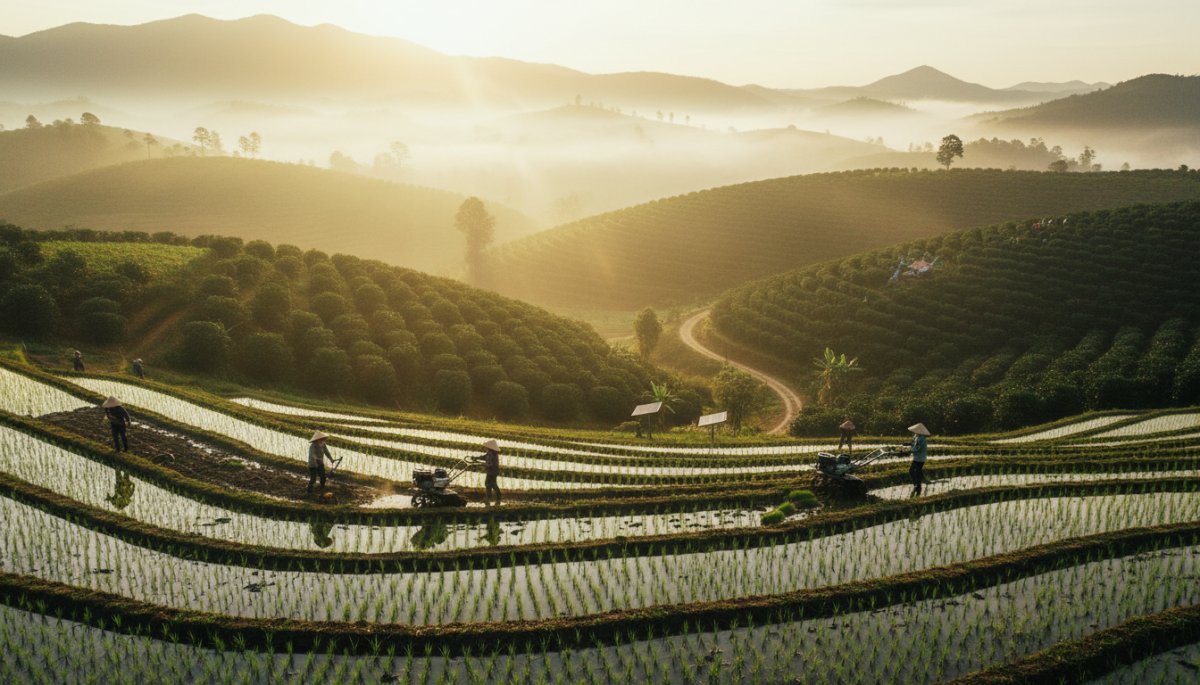
Southeast Asia is one of the world's leading agricultural regions, and Vietnam in particular draws attention as an agricultural power with a population of about 100 million. Its rice exports are second in the world, coffee output is second in the world, and cashew nuts and black pepper boast the world's largest output. In 2023, total agriculture, forestry and fishery exports were about US$53 billion, said to make up more than 15% of the country's exports overall.
Yet behind these dazzling achievements, Vietnamese agriculture faces serious structural challenges. The average farm holding is just about 0.44 hectares, among the smallest in ASEAN. 97% of all farmers are small- and medium-scale, about 57% of the agricultural labor force is unskilled, and those aged 50 and over make up about 42.8% (organized based on B-Company's 2024 survey, "Smart Agriculture Future: Vietnam's Path").
This article analyzes the current state of Vietnamese agriculture and the potential for income improvement from the perspectives of Japanese agriculture professionals, investors and researchers. We hope it helps deepen understanding of Southeast Asian agriculture and explore future business opportunities and directions for cooperation.
1. The potential to improve profitability by shifting to high-value crops
Breaking away from rice dependence and choosing cash crops
Vietnam boasts an annual rice output of about 43.5 million tonnes, but much of it is exported as unprocessed primary produce, so farmers' take-home earnings are limited. Meanwhile, cash crops such as coffee, cashew nuts and black pepper have stable demand on international markets and tend to offer higher returns per unit area.
The specialty-coffee strategy of the Central Highlands
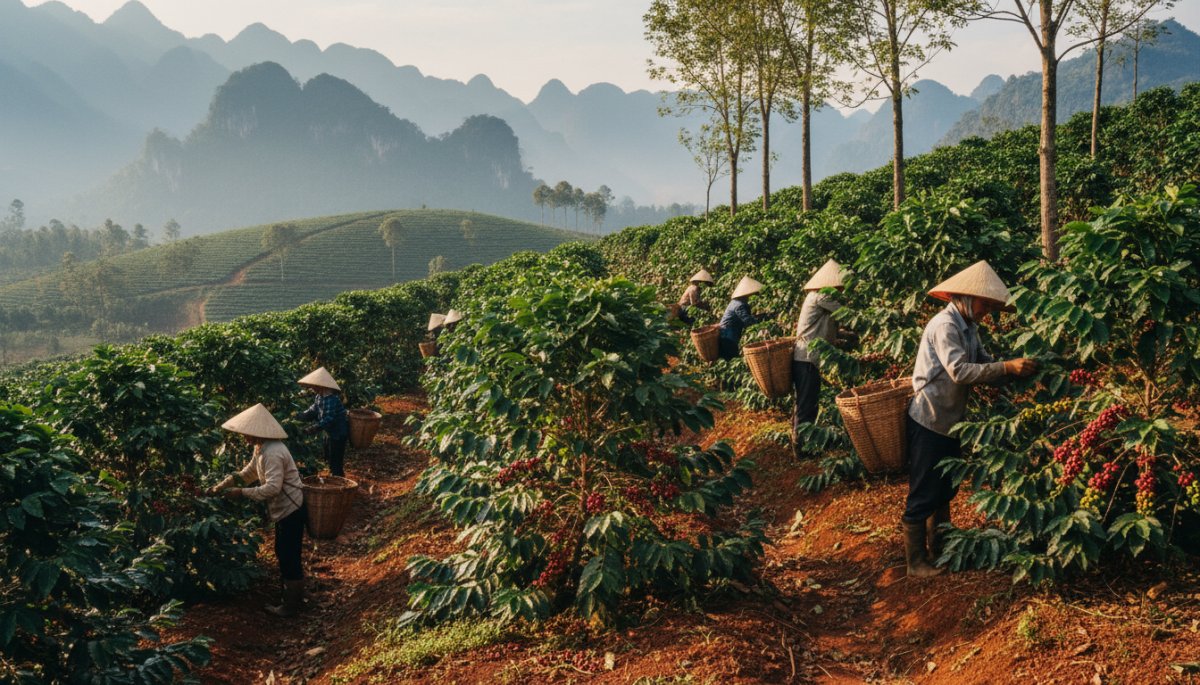
In Dak Lak and Lam Dong provinces in the Central Highlands, coffee growing has been directly tied to boosting farmers' incomes. With its spread of volcanic red soil, this region has conditions suited to coffee cultivation and has established the world's largest position in Robusta production. Entering the 2020s, Arabica cultivation has also increased, and entry into the higher-priced specialty market is advancing.
Da Lat highland vegetables and the effect of GAP certification
The area around Da Lat in Lam Dong Province is known as a producing area for highland vegetables that make use of the cool climate, and the introduction of greenhouse cultivation systems has achieved stable year-round supply. Urban consumers are willing to pay high prices for safe, high-quality vegetables, and there are reports of produce with GAP (Good Agricultural Practice) certification trading at higher prices than ordinary goods.
Source Ministry of Agriculture, Forestry and Fisheries, "The Current State of Vietnamese Agriculture and Its Agricultural and Trade Policy"(FY2020)
2. Efforts to create added value through sixth-industrialization
The government's food-processing promotion measures and 2030 target
Handling not just production but processing and sales Sixth-industrialization has the potential to raise farmers' incomes. The Vietnamese government has set a goal of entering the world's top 15 in agriculture and food processing by 2030, and is promoting investment attraction into processing facilities, the development of cold chains, and stronger branding.
Raising shelf stability and logistics efficiency through drying and powdering
Drying and powder processing are primary-processing techniques that even small farmers can take on. Tropical produce spoils quickly and is hard to transport long distances or store for long periods as is, but drying or powdering raises shelf stability and cuts logistics costs. Dried vegetables, dried fruit and freeze-dried products are seeing expanding demand in developed markets against a backdrop of rising health consciousness.
A case of joint processing in Mekong Delta shrimp farming
In the Mekong Delta, there are cases where shrimp-farming households jointly run processing and freezing facilities to produce high-value products for export. Compared with shipping raw shrimp as is, peeling, flash-freezing and packaging them can raise the selling price. Such efforts, difficult for individual farmers, become possible through cooperatives and producer groups.
3. Improving bargaining power and efficiency through cooperatives
Securing price competitiveness through joint purchasing and joint shipping
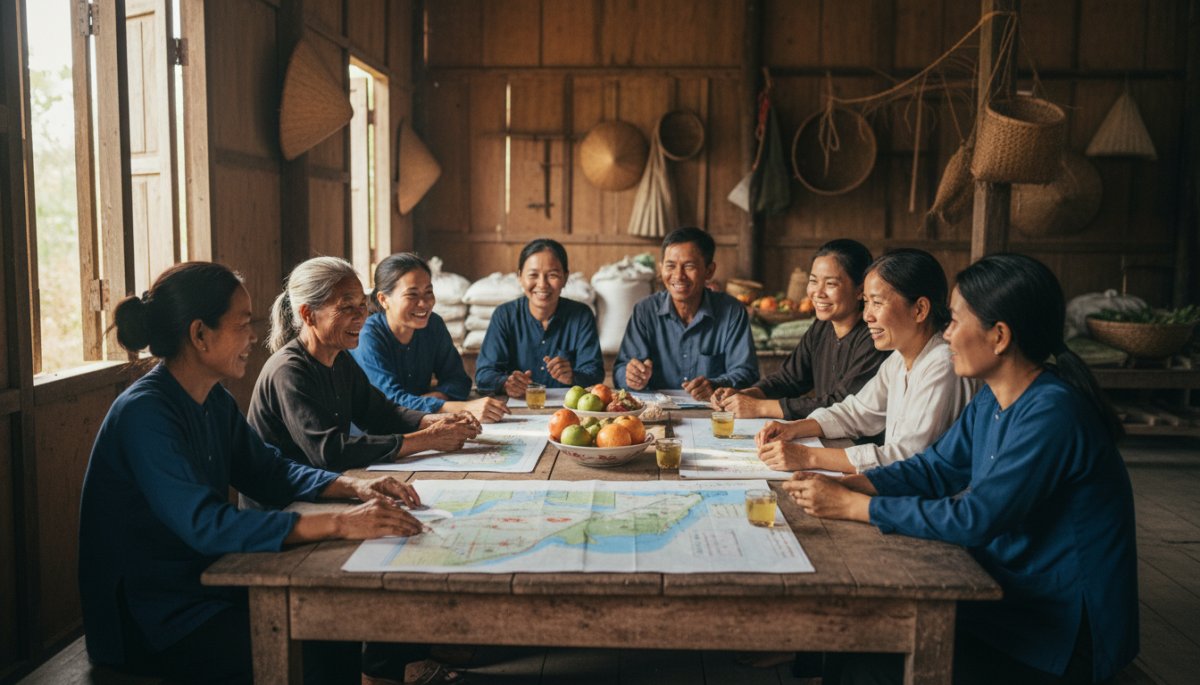
It is difficult for small farmers to face the market alone. Joining a cooperative is a means to achieve both stronger bargaining power and improved production efficiency at the same time.
Vietnam has thousands of agricultural cooperatives, providing varied support such as joint purchasing of seeds and fertilizer, joint shipping of produce, and technical training. Joint purchasing can be expected to cut input costs, and joint shipping tends to strengthen price bargaining power against middlemen.
Cooperative functions that support the whole value chain
In Vietnam, agricultural value-chain development projects supported by the World Bank and ADB are under way in many areas, and systems that provide integrated support for quality control, certification and export procedures through cooperatives are taking shape. Cooperatives are beginning to expand their role beyond mere collection organizations into hubs for branding and overseas market development.
Compressing upfront investment through shared use of farm machinery
Cooperatives also make possible the shared use of expensive farm machinery that is beyond the reach of individual farmers. By jointly purchasing and managing equipment such as tractors, combines and dryers, they can ease the burden of upfront investment while improving productivity.
4. The current state and challenges of adopting smart agriculture
Smart agriculture as a national strategy
Smart agriculture, which uses advanced technologies such as IoT, AI and drones, has the potential to improve productivity, but challenges remain for its diffusion.
The Vietnamese government, under its "Strategy for Sustainable Agriculture and Rural Development to 2030, with a Vision to 2050," positions the adoption of smart agriculture as a national priority. A wide range of technologies are being demonstrated around the country, such as environmental monitoring with IoT sensors, pesticide spraying by drones, pest and disease prediction using AI, and automation of hydroponics.
Precision irrigation and water-saving rice farming in the Mekong Delta
In the Mekong Delta, demonstrations of water-saving rice farming through the introduction of water-management systems are advancing. Switching from conventional flooded cultivation to precision irrigation using soil-moisture sensors is expected to cut water use while maintaining or improving yields. As dry-season water shortages and saltwater intrusion worsen, this is a realistic technology option.
Technical cooperation with Japanese firms and remote cultivation support
Technical cooperation by Japanese firms is also active, with demonstration projects for introducing small- and medium-scale greenhouses and remote cultivation-support solutions. Services that let farmers receive expert advice in real time via a smartphone app have also appeared, helping to correct the technology gap.
The challenge of diffusion to small farmers and lowering costs
However, adopting smart agriculture requires upfront investment, and diffusion to small farmers who lack capital is the biggest challenge. Given that 97% of all farmers are small- and medium-scale, there is a need to develop low-cost smart-agriculture models that do not presuppose expensive equipment.
5. Shifting to organic farming and promoting environmentally conscious agriculture
Why organic farming works for incomes
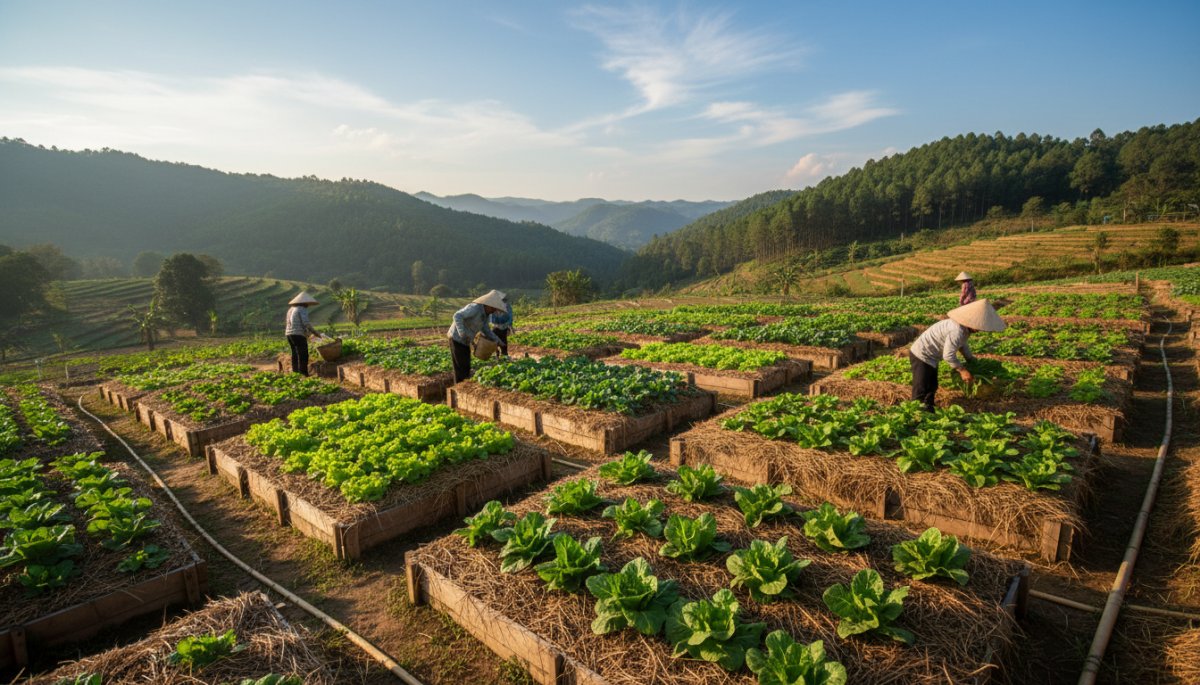
Organic farming, which limits the use of chemical pesticides and fertilizers, is a strategy that reconciles environmental protection with higher earnings. Demand for organic-certified produce is expanding in major export destinations such as Japan, the EU and North America, and obtaining certification translates directly into effectively higher selling prices. International cooperation frameworks such as the "Japan-ASEAN Green Cooperation Plan" discussed later also work to lower the cost of converting to organic.
The market premium for organic-certified produce
Organic-certified produce tends to be highly valued in domestic and overseas markets. Affluent urban consumers and health-conscious shoppers are willing to pay higher prices than for ordinary goods for safe, environmentally friendly produce. In the EU and US markets, organic certification is sometimes a condition of entry, so for farmers aiming to expand exports, converting to organic is an important option.
Dealing with yield declines during conversion and certification costs
On the other hand, converting to organic often comes with a temporary drop in yield, and for small farmers without margin the risk is genuinely large. The cost of obtaining organic certification and the complexity of production management that meets certification standards are also barriers. There is a need to build mechanisms that back conversion from both the technical-support and economic-incentive sides.
6. Opportunities and challenges in developing export markets
The global market position of flagship products
Beyond the domestic market, expanding into overseas markets has the potential to raise farmers' incomes. Vietnam's total agriculture, forestry and fishery exports reached about US$53 billion in 2023, accounting for more than 15% of the country's total exports. Many products are competitive on world markets, including rice, coffee, cashew nuts, pepper and seafood.
The effect of tariff elimination under the CPTPP and EVFTA
Through the CPTPP (Comprehensive and Progressive Agreement for Trans-Pacific Partnership) and the EU-Vietnam FTA (EVFTA), Vietnam has expanded access to developed-country markets. With the EVFTA's entry into force in particular, tariffs on coffee, pepper, seafood and others are being phased out, improving competitiveness in the EU market.
Addressing residual pesticides and traceability
To enjoy the benefits of FTAs, you must meet the destination's quality and hygiene standards, which is a barrier to entry for small farmers. Compliance with international standards is required, such as residual-pesticide standards, traceability (the ability to track production history), and Sanitary management and other international standards are required.
The EUDR and blockchain origin tracking
From 2024 onward, compliance with the EU Deforestation Regulation (EUDR) has become an important issue for farmers exporting coffee, natural rubber, cacao and the like. The introduction of blockchain-based origin-tracking systems and the spread of GAP certification are being attempted, but overall it is still at an early stage. Advancing compliance with such standards through cooperation with cooperatives and exporters will be the key to developing export markets.
7. Risk management through agricultural finance and insurance
Supporting capital investment through policy finance
Agriculture is easily swayed by weather and market prices, so risk management is an important element of income stabilization. In Vietnam, agricultural lending systems are being developed, with government-affiliated financial institutions and commercial banks providing low-interest loans for capital investment and working capital. Introducing smart-agriculture technology and converting to organic farming require upfront investment, and using such lending systems is a precondition for income improvement.
Climate disasters and the role of agricultural insurance
Agricultural insurance is also gradually spreading. Vietnam, especially along the central coast, is hit by several typhoons and tropical depressions every year, and faces region-specific natural-disaster risks such as flooding in the northern Red River Delta and saltwater intrusion and drought in the southern Mekong Delta. Because a single disaster can wipe out most of a year's income, taking out agricultural insurance is spreading as a practical means of raising management stability.
Climate change and the spread of disaster-resistant varieties
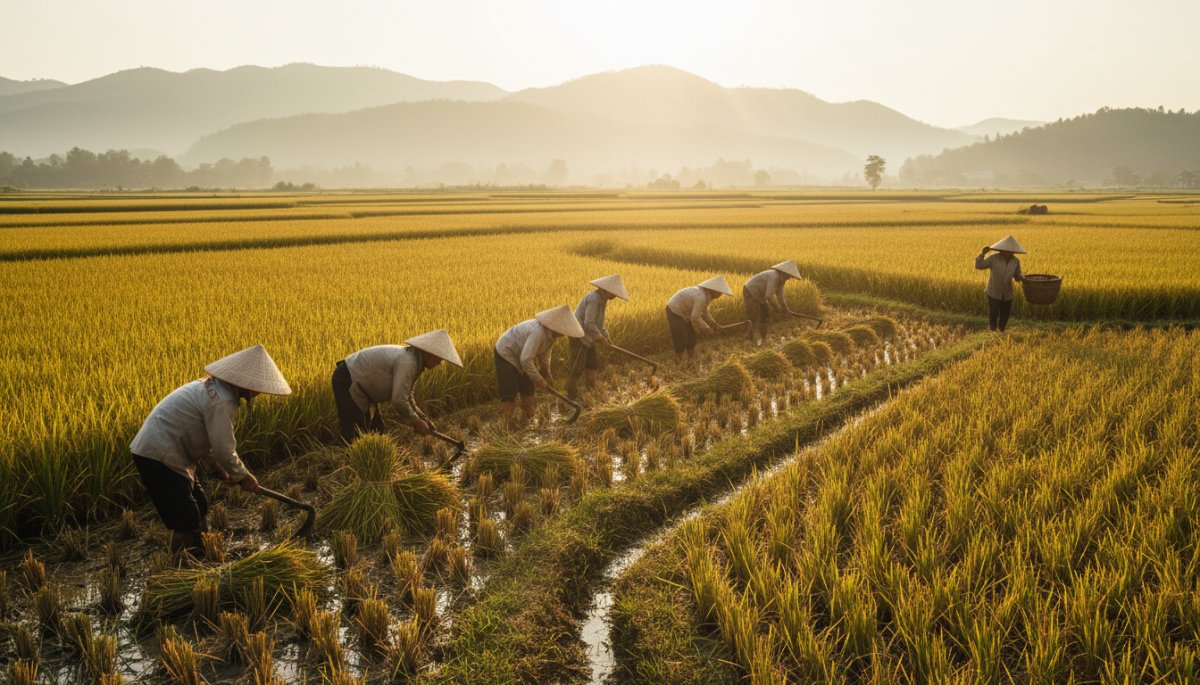
As the impact of climate change worsens year by year, developing and spreading disaster-resistant varieties is drawing attention as a pillar of risk management. The selection of salt-tolerant and submergence-tolerant rice varieties and drought-resistant coffee seedlings is advancing through cooperation between local research institutions and international organizations.
8. Improving technical training and access to information
Disparities in access to training programs
Access to new technology and market information is the foundation for improving farmers' incomes. About 57% of Vietnam's agricultural workers are said to be unskilled, and limited opportunities for technical training are an obstacle to improving productivity. Participating in training programs run by the government, international organizations such as JICA and FAO, and NGOs is a chance to learn the latest cultivation techniques, pest and disease management, soil improvement, and marketing methods.
Using varieties from the International Rice Research Institute (IRRI) in Vietnam
Vietnam has widely adopted the flood-tolerant variety "Sub1" and salt-tolerant varieties developed by the International Rice Research Institute (IRRI) in rice farming in the Mekong and Red River deltas. How to deliver such international research results to farmers on the ground holds the key to income improvement. Setting up variety-trial plots through cooperation between province-level extension officers and cooperatives functions as a realistic diffusion route.
Digital support expanding with smartphone diffusion
The use of digital technology is also advancing. Services that provide weather forecasts, market-price information and cultivation advice in real time via smartphone apps have appeared, helping to correct information gaps. The spread of such digital tools is also essential to encouraging younger generations to enter farming.
Source Tokai University, "Trends in the Agriculture-Industry Gap in ASEAN Countries"(2021)
The Japan-ASEAN Green Cooperation Plan and Japan's opportunities for involvement
The positioning of the Japan-ASEAN Green Cooperation Plan
The "Japan-ASEAN Green Cooperation Plan," adopted at the Japan-ASEAN agriculture and forestry ministers' meeting in May 2023, is a comprehensive cooperation framework for building sustainable agriculture and food systems in the Asian monsoon region. Japan positions ASEAN as its most important partner for the international rollout of the environmental-impact-reducing technologies set out in its "Strategy for Sustainable Food Systems (MIDORI)." Specifically, it includes promoting organic farming, spreading smart-agriculture technology, supporting climate-change adaptation, and strengthening agricultural value chains, connecting technically and financially to each strategy that directly bears on raising Vietnamese farmers' incomes.
Patterns of involvement on the Japanese side
For Japanese agriculture professionals, Southeast Asia, and Vietnam in particular, is an important partner for cooperation and also a business opportunity. Multiple patterns of involvement are available: technical cooperation (JICA and private-sector partnerships), capital investment, trade, raw-material sourcing, and human exchange. The latest trends in Southeast Asian agriculture can be the Asian agriculture category reviewed all together here. You can also check comparative data and cooperation-project cases for Thailand, Indonesia and the CLMV countries.
Summary: the potential of Vietnamese agriculture and Japan's role
The path for Vietnamese farmers to raise their incomes is by no means smooth. Many challenges exist, such as small-scale management, aging, technology gaps and climate change. However, by combining the eight strategies introduced in this article, such as shifting to high-value crops, Sixth-industrialization, using cooperatives, adopting smart agriculture, converting to organic farming, developing export markets, using agricultural finance and insurance, and technical training and information access, there is potential to raise profitability.
What matters is not trying to achieve everything at once, but steadily tackling the strategies that suit the scale of the operation and local characteristics. Using cooperatives, government support schemes and international cooperation programs, and sharing information while advancing step by step, is the road to sustainable income improvement.
Vietnamese agriculture is now at a turning point, shifting "from quantity to quality." This change is also an opportunity for Japanese agriculture professionals, for technical cooperation and business development. the Asian agriculture category also provides information on the details of the Japan-ASEAN Green Cooperation Plan and on specific ways to participate.
Frequently asked questions
What is the average income of Vietnamese farmers?
According to a survey by Vietnam's General Statistics Office (GSO), monthly per-capita income in rural areas was around 4 million dong as of 2022 (roughly 24,000 yen), only about half that of urban areas. Regional and crop differences are large, and coffee farmers in the Central Highlands and export-oriented fruit growers in the Mekong Delta often earn above-average incomes.
Which strategy is most likely to improve incomes?
The best answer varies with operation scale, region and crop. For small farmers under 1 ha, the first step is joining a cooperative and securing bargaining power through joint shipping. For mid-scale operations of 2 ha or more, sixth-industrialization (primary processing) and obtaining export-oriented GAP certification are strategies that more readily raise returns per unit area.
What are the realistic options for Japanese firms entering Vietnamese agriculture?
The main entry patterns are four types: (1) technology provision and contract farming, (2) processing and export businesses through a local subsidiary, (3) overseas expansion of SMEs using JICA and JETRO support, and (4) building a raw-material sourcing network. Building relationships with cooperatives and provincial governments is the key to long-term business stability.
Which crops are covered by EUDR compliance?
The EU Deforestation Regulation (EUDR) covers coffee, cacao, natural rubber, palm oil, soy, beef, timber and their derived products. For exports from Vietnam, the impact on coffee and natural rubber is large, and proof of production coordinates and deforestation-free origin is required.
How much time and cost does obtaining organic certification take?
The conversion period is usually 2 to 3 years, during which the produce cannot be sold as organic-certified. Certification costs vary by plot size and certifying body, but with group certification they can be kept to the order of tens of thousands of yen per farm per year. Obtaining it via a cooperative is the realistic route.
You May Also Like
- How to Succeed at Sixth-Industrialization in Vietnamese Agriculture: 8 Strategies to Add Value
- The essence of Vietnam's agricultural problems and their solutions: addressing the challenges small-scale farmers face
- How Can Asia's Smallholder Farmers Raise Their Earnings? 8 Measures That Lead to Higher Incomes