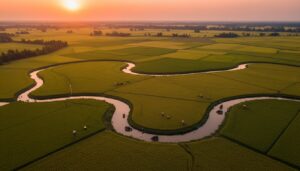
When people think of Cambodia, the image of Angkor Wat and tourist destinations may be the strongest. But in recent years, the country's presence in agriculture has grown rapidly.
Cambodia, which once barely managed food self-sufficiency, has now stepped onto the world market as a rice-exporting country. Its organic jasmine rice is highly regarded in Europe, and its cashew nut output has grown to one of the largest in Asia.
This article explains the current state of Cambodian agriculture, the background to its changes, and how it relates to business in Japan and Southeast Asia.
Basic Data on Cambodian Agriculture
First, let's get the big picture. Cambodia's agricultural sector accounts for about 20–22% of GDP. The rural population share is high, and some 70% of the population is said to earn a living connected to agriculture.
An overview of the main agricultural products is as follows.
| Crop | Characteristics | Main export destinations |
|---|---|---|
| Jasmine rice | High-quality aromatic rice; organic certification is advancing | EU, China, USA |
| Cashew nuts | Output is surging; processing has also grown in recent years | Via Vietnam; Europe and the USA |
| Cassava | Grown over vast areas; used for feed and starch | China |
| Natural rubber | Growing area is expanding in the northwest and north | China, Vietnam |
| Sugar (sugarcane) | Production for export is increasing | EU (preferential tariff applied) |
The farmland area is roughly 5.7 million hectares. The abundant water resources of the Mekong River basin and a tropical climate support diverse agriculture.
The Background to Cambodia's Shift to a Rice-Exporting Country
Until the early 2000s, Cambodia could barely cover its own domestic consumption. The turning point was the investment in agricultural infrastructure that followed the post–civil war recovery period.
The government set out a "rice export promotion policy," working on building milling facilities and simplifying export licensing. As a result, annual export volume exceeded one million tonnes for the first time in 2013.
In recent years the strategy has shifted toward an emphasis on quality. Rather than large volumes of cheap rice, the direction is to raise unit prices by focusing on high-quality jasmine rice.
Data from 2022–2023 shows Cambodia's rice exports hovering at around 650,000–700,000 tonnes per year. Owing partly to the pandemic and rising logistics costs, volumes have settled below their peak, but on an export-value basis they remain at a high level.
The Branding Strategy for Organic Jasmine Rice
The most notable development in Cambodian agriculture right now is the branding of organic jasmine rice.
Known as "fragrant rice," Cambodian jasmine rice has placed highly at international rice competitions. Between 2012 and 2015, it earned the title of "world's best" at several such contests.
The Status of Organic Certification
Using no pesticides or chemical fertilizers, organic cultivation is spreading, mainly in rural areas. The number of farmer groups that have obtained EU organic or USDA organic certification is also rising.
The key point is that certification is being pursued not by individual farmers but through "group certification." Smallholders form cooperatives and obtain certification collectively, keeping costs down. This arrangement is helping drive the spread of organic farming.
The Connection to the Japanese Market
In Japan, too, Cambodian organic rice has started to appear at some natural-food stores and specialty importers of foreign foods. It is cheaper than Thai or domestic rice, and its reputation for quality is rising.
For businesses considering food imports, Cambodian organic jasmine rice could be a cost-effective option.
The Rapid Expansion of Cashew Nut Cultivation
After rice, the crop drawing the most attention is the cashew nut.
Cambodia's cashew-growing area has expanded rapidly over the past decade. It is now estimated to reach some 700,000–800,000 hectares, making the country one of the leading producers in Southeast Asia.
The Challenge Is "In-House Processing"
There is, however, a major challenge. Much of the cashew harvested in Cambodia is exported raw to neighboring Vietnam. In reality, it is in Vietnam that the nuts are processed and shelled before reaching the world market.
To promote domestic processing, the Cambodian government has rolled out preferential investment measures for processing facilities. Domestic processing volume is gradually increasing, but it is thought to remain at only around 20–30% of the total.
If in-house processing advances, there is potential for a major improvement in added value and farmer income. The next five to ten years will be an important turning point.
The Relationship with Vietnam
When it comes to cashews, the agricultural supply chains of Cambodia and Vietnam are closely intertwined. Vietnam is the world's largest cashew processor and exporter, and it imports large quantities of Cambodian raw material.
When Japanese food importers buy "Vietnamese cashews," it is not uncommon for some of the raw material to actually be from Cambodia.
The Front Line of Agricultural Modernization
Cambodia's agriculture is shifting from traditional smallholder farming toward modernization. Here are a few of the developments.
The Introduction of Drones and Smart Farming
In rural areas near cities, drone-based pesticide spraying and growth management are being introduced on a trial basis. In many cases, Chinese companies and NGOs provide technical support.
The Development of Irrigation Infrastructure
In Cambodia, where the gap between the rainy and dry seasons is large, irrigation is essential for stable farming. Japan's ODA (Official Development Assistance) has long contributed to irrigation infrastructure development as well.
As the irrigation network expands by drawing on the water resources of the Mekong River basin, more regions can now manage double cropping and triple cropping even in the dry season.
The Expansion of Agricultural Finance and Microfinance
Financing for farmers to buy seeds and farm equipment had been a challenge. In recent years, microfinance institutions (MFIs) have penetrated rural areas, creating an environment in which even smallholders can more easily obtain loans.
Interest rates on agricultural loans remain high, but with intensifying competition they are gradually trending downward.
Comparison and Cooperation with Vietnamese Agriculture
Cambodia and Vietnam have a close relationship in agriculture as well. Comparing the two countries' farming brings their differing characteristics into view.
| Comparison item | Cambodia | Vietnam |
|---|---|---|
| Rice output | About 10 million tonnes per year | About 43 million tonnes per year |
| Organic farming | Expanding; branding advancing | Ahead in some regions |
| Agricultural mechanization rate | Low to moderate | Moderate to high |
| Main export products | Jasmine rice, cashew nuts | Rice, coffee, vegetables |
| Agriculture's share of GDP | About 20–22% | About 11–12% |
Compared with Vietnam, Cambodia's agriculture is still at a developing stage. That said, it can also be read as "plenty of room to grow."
In the field of organic-certified produce, there are even cases where Cambodia started earlier. One reason is that many of its farmlands have only a short history of pesticide use, which lowers the hurdle for converting to organic.
Summary
Let's organize the key points about Cambodian agriculture.
- Rice exports have shifted to an emphasis on quality, with organic jasmine rice brands raising their international reputation
- Cashew output is expanding rapidly; in-house processing is the key going forward
- Agricultural modernization is underway but still developing; irrigation, smart farming, and agricultural finance are challenges
- The supply chain with Vietnam is close, so a view that takes both countries together is important
Cambodian agriculture is at a turning point, shifting from "cheap mass production" to "high-quality, organic brands." For food importers and those involved in agriculture, now is a moment worth watching.
At VN AGRI, we share the latest information on Vietnamese agriculture. We also deliver trends in Southeast Asian agriculture, including Cambodia, from time to time, so please take a look.