
The current state and potential of Southeast Asian agriculture
As one of the world's leading agricultural regions, Southeast Asia has nurtured a farming civilization spanning thousands of years.
Vietnam is an agricultural powerhouse with a population of about 100 million, where agriculture accounts for roughly 12% of GDP and employs more than 40% of the workforce. Annual rice production is about 43.5 million tonnes and export volume ranks second in the world; coffee production is second in the world after Brazil and the largest for the Robusta variety; and cashew nuts and black pepper rank first in the world, and shrimp boasts third place in the world by output and second by export value.
Thailand is known as the 'kitchen of the world'; its natural rubber output and exports are among the world's largest, and it is also world-class in exports of processed chicken products. Indonesia is Palm oil the world's largest producer of, and together with Malaysia it accounts for more than 85% of world output.
The regional characteristics and production structure of Southeast Asian agriculture
Southeast Asian agriculture has developed against the backdrop of a tropical monsoon climate and fertile delta regions.
The two great deltas that support Vietnamese agriculture
Vietnamese agriculture is supported by the Red River Delta in the north and the Mekong Delta in the south, and the Mekong Delta is one of the world's leading production areas, responsible for more than half of domestic rice output. The Central Highlands are a major producing area for plantation crops such as coffee, tea, cacao, and pepper, and it can be said that the contribution of this region lies largely behind Vietnam becoming a coffee powerhouse.
The total value of agriculture, forestry, and fishery exports reached about US$53 billion in 2023, accounting for more than 15% of the country's total exports.
The agricultural characteristics of Thailand, Indonesia, and the Philippines
In Thailand, agriculture accounts for about 8-9% of GDP, and about 30% of the population works in agriculture-related jobs. The cultivated area per farm averages about 3 hectares, and jasmine rice has earned a high reputation in international markets.
Indonesia has the largest population in ASEAN, about 280 million, and the largest land area, and is also the largest in ASEAN by agricultural output value. The Philippines holds one of the world's leading positions in banana exports, while it carries the risk of severe crop damage from nearly twenty typhoons approaching or making landfall each year on average. As ASEAN's only net rice importer, vulnerability in food security is a challenge.
The agricultural dependence of Cambodia, Myanmar, and Laos
In Cambodia, Myanmar, and Laos, agriculture still accounts for a high share of GDP and employment, making agriculture's importance to economic development stand out.
The Agricultural Transformation Brought About by the Doi Moi Policy
In discussing the development of Vietnamese agriculture, the 1986 Doi Moi policy is indispensable.
When this policy granted land-use rights to individual farmers and introduced a market economy, agricultural production expanded dramatically. In 1989, it became a net rice exporter for the first time, and Vietnamese agriculture entered a new era.
Market-economy reform raised farmers' motivation to produce and promoted export-oriented agricultural development. The production of export crops such as coffee, cashew nuts, and black pepper and other export crops surged, and Vietnam came to show its presence in the world market.
Five structural challenges facing Southeast Asian agriculture
Southeast Asian agriculture has achieved remarkable development, but it also faces serious structural challenges.
Challenge 1: The low productivity of smallholder farmers
The average cultivated area per farm in Vietnam is about 0.44 hectares, among the smallest in ASEAN countries. 97% of all agricultural workers are small- and medium-scale farmers, a structure in which economies of scale are hard to achieve.
Smallholder farmers have little capital, making it difficult to invest in the latest technology and equipment. As a result, productivity improvement does not progress, posing a challenge in terms of international competitiveness.
Challenge 2: The aging and deskilling of the agricultural workforce
In Vietnam, about 57% of agricultural workers are unskilled, and the share aged 50 or older reaches about 43%. The outflow of young people to cities continues, and aging is progressing rapidly in rural areas.
Passing on skilled agricultural techniques is becoming difficult, and labor shortages the shortage of successors is also growing serious.
Challenge 3: Low added value and underdeveloped value chains
Southeast Asian agriculture is skewed toward raw-material production, with weak downstream segments such as processing, distribution, and marketing. Because cold chains are underdeveloped, post-harvest losses are also large, and mechanisms for raising the added value of produce are lacking.
Challenge 4: Food safety and environmental problems
In Vietnam, soil degradation and water pollution from excessive use of pesticides and chemical fertilizers, and pesticide-residue problems, are growing serious, posing the challenges of health risks to domestic consumers and meeting the hygiene standards of destination countries.
Ensuring food safety and traceability is also an important challenge for strengthening competitiveness in international markets.
Challenge 5: Vulnerability to climate change
Southeast Asia is a region easily affected by climate change. Rising sea levels, the increasing frequency of extreme weather, and changes in rainfall patterns have a major impact on agricultural production. In the Mekong Delta, saltwater intrusion from rising sea levels is growing serious, raising concerns about its impact on rice cultivation.
The future of Southeast Asian agriculture opened up by smart farming
Drawing attention as a solution to these challenges is the introduction of smart farming.
The Vietnamese government's smart farming promotion strategy
The Vietnamese government has set out its "Strategy for Sustainable Agriculture and Rural Development to 2030, with a Vision to 2050," positioning the adoption of smart agriculture as a national priority.
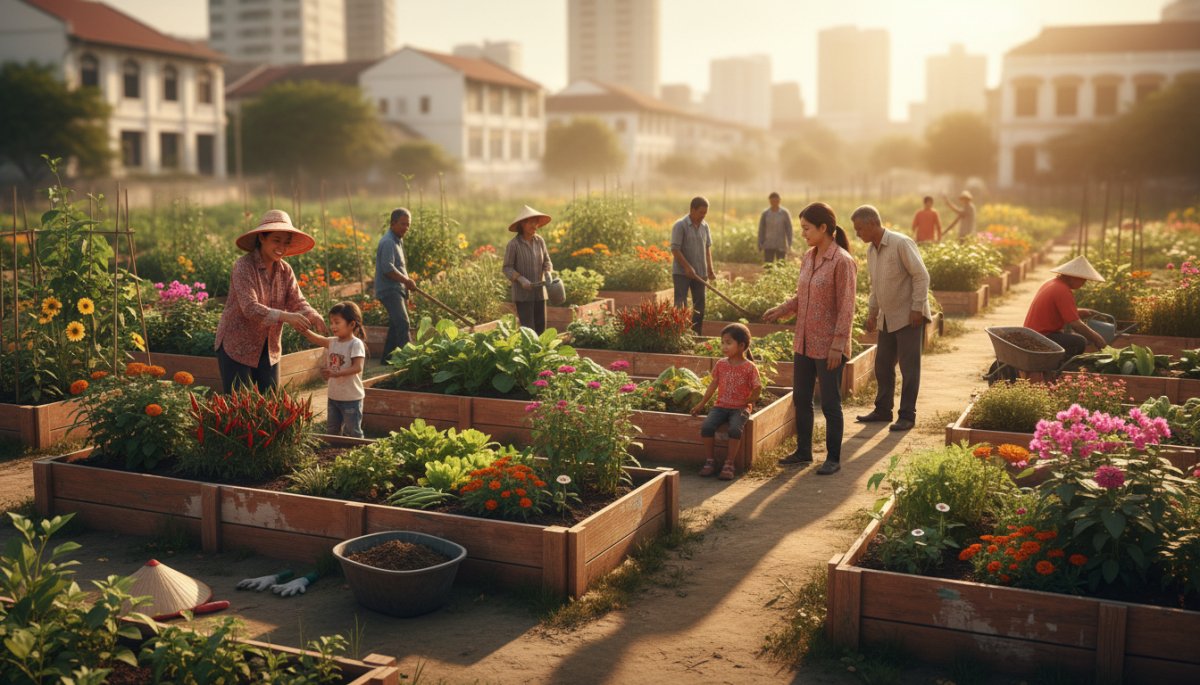
Around Da Lat in Lam Dong Province, greenhouse systems for vegetable cultivation and automated irrigation systems have been introduced, making it a leading region for smart farming in Vietnam. In the Mekong Delta, demonstrations of water-saving rice cultivation through the introduction of water management systems are advancing.
Applying IoT and AI technology to agriculture
Through the introduction of advanced technologies such as environmental monitoring with IoT sensors, automated irrigation systems, and pest forecasting using AI, it is hoped that improved productivity and reduced environmental impact can be achieved together.
The introduction of origin-tracking systems using blockchain technology and the spread of GAP (Good Agricultural Practices) certification are also being attempted, contributing to ensuring food safety and improving traceability.
The importance of developing technology suited to small- and medium-scale farmers
Given that 97% of all agricultural workers are small- and medium-scale farmers, developing a low-cost smart farming model that even smallholder farmers with limited capital can adopt is important.
Demonstration projects by Japanese companies for introducing small- and medium-scale greenhouses and remote cultivation support solutions are being rolled out across Southeast Asia, and the spread of technology that fits the realities of smallholder farmers is advancing.

The Japan-ASEAN Midori Cooperation Plan and the framework of international cooperation
International cooperation plays an important role in the sustainable development of Southeast Asian agriculture.
Overview of the Japan-ASEAN Green Cooperation Plan
The "Japan-ASEAN Midori (Green) Cooperation Plan," adopted at the Japan-ASEAN Agriculture and Forestry Ministers' Meeting in May 2023, is a comprehensive cooperation framework for building sustainable agriculture and food systems in the Asian monsoon region.
This cooperation plan promotes cooperation in a wide range of fields, including responding to climate change, spreading smart farming, strengthening agricultural value chains, and improving food safety.
The potential to use Japan's technology and know-how
Japan's strength lies in having technology and know-how suited to small- and medium-scale farmers. It is highly likely to fit the realities of Southeast Asia's smallholder farmers, and cooperation through technology transfer and human-resource development is expected.
Japan's agricultural cooperatives systems and its experience in Sixth-industrialization may also help strengthen Southeast Asia's agricultural value chains.
Seven points for the success of Southeast Asian agriculture
For Southeast Asian agriculture to achieve sustainable development, the following points are important.
Point 1: The phased introduction of smart farming technology
A strategy of starting with low-cost technology that even smallholder farmers can adopt and gradually moving to more advanced technology is effective. Rather than making a large investment all at once, introducing cost-effective technology first makes it possible to improve productivity while keeping risk down.
Point 2: Strengthening agricultural value chains
Not only production but the strengthening of the entire agricultural value chain, including processing, distribution, and marketing, is needed. Developing cold chains, enhancing processing facilities, and supporting the opening of sales channels can raise the added value of produce.
Point 3: Ensuring food safety and traceability
To strengthen competitiveness in international markets and win the trust of domestic consumers, ensuring food safety and improving traceability are indispensable. Support for obtaining GAP certification, developing pesticide-residue inspection systems, and the use of blockchain technology are effective.
Point 4: Implementing climate change adaptation measures
Building agricultural systems adapted to climate change is important, including developing salt-tolerant varieties, spreading water-saving agriculture, and building disaster-risk management systems. In the Mekong Delta, as a measure against rising sea levels, the shift to crops resistant to saltwater intrusion and improvements in water management systems are being advanced.
Point 5: Promoting young people's entry into farming
To respond to the aging of agriculture, making farming attractive to young people is needed. By reducing the labor burden through the introduction of smart farming technology and improving profitability through adding high value, young people's entry into farming can be promoted.
Point 6: Strengthening and organizing agricultural cooperatives
Technology adoption and sales-channel development that are difficult for smallholder farmers alone can be achieved through cooperatives. Reducing input costs through joint purchasing, raising bargaining power through joint shipment, and jointly conducting technical training become possible.
Point 7: Using government support and international cooperation
By actively using government support systems and international cooperation programs, the burden of initial investment can be reduced and the acquisition of technology accelerated. International cooperation frameworks such as the Japan-ASEAN Midori Cooperation Plan are valuable opportunities for technology transfer and human-resource development.
The outlook and potential of Southeast Asian agriculture
Southeast Asian agriculture, while facing many challenges, holds great potential.
Its natural conditions as one of the world's leading agricultural regions, abundant labor, growing intra-regional market, and opportunities for technology transfer through international cooperation. By making the most of these elements, a shift to sustainable and competitive agriculture is expected.
The introduction of smart farming technology, strengthening agricultural value chains, improving food safety, and adapting to climate change. Through these efforts, Southeast Asian agriculture is achieving a shift from quantity to quality.
Vietnam's rice export second in the world by output, and coffee output Achievements such as ranking second in the world and being first in the world in cashew nut and black pepper output show the latent power of Southeast Asian agriculture. The challenge ahead is to draw out this potential to the fullest and achieve sustainable development.
International cooperation frameworks, led by the Japan-ASEAN Midori Cooperation Plan, are an important foundation supporting the development of Southeast Asian agriculture. Through multifaceted cooperation, technology transfer, human-resource development, and support for market development, it is hoped that the sustainable development of Southeast Asian agriculture will be achieved.
Conclusion: Toward the Sustainable Development of Southeast Asian Agriculture
As one of the world's leading agricultural regions, Southeast Asia plays an important role in the global food supply.
Vietnam is an agricultural powerhouse with a population of about 100 million, where agriculture accounts for about 12% of GDP and employs more than 40% of the working population, and the total value of agriculture, forestry, and fishery exports reached about US$53 billion in 2023. Thailand as the 'kitchen of the world,' and Indonesia as the Palm oil world's largest producer of palm oil, each hold an important position in international markets.
On the other hand, they also face structural challenges such as the low productivity of smallholder farmers, the aging of the agricultural workforce, low added value, food safety and environmental problems, and vulnerability to climate change.
As solutions to these challenges, the introduction of smart farming, the strengthening of agricultural value chains, the improvement of food safety, and the implementation of climate change adaptation measures are being advanced. The 'Japan-ASEAN Midori Cooperation Plan,' adopted at the Japan-ASEAN agriculture and forestry ministers' meeting in May 2023, supports the development of Southeast Asian agriculture as a comprehensive cooperation framework aimed at building sustainable agriculture and food systems.
The sustainable development of Southeast Asian agriculture contributes not only to the region's food security but also to the stability of the global food supply. Through technological innovation and international cooperation, Southeast Asian agriculture is about to enter a new era.