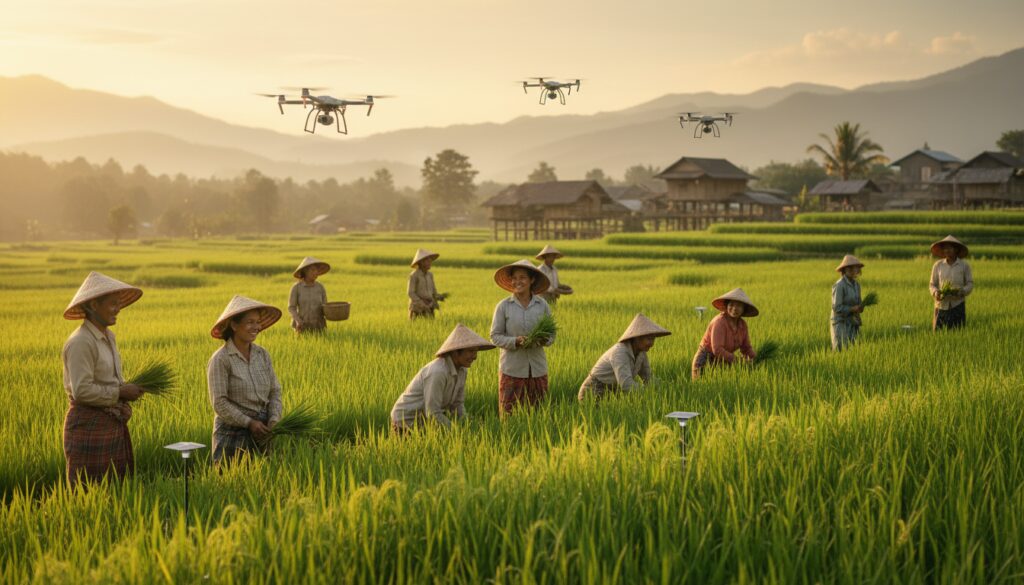
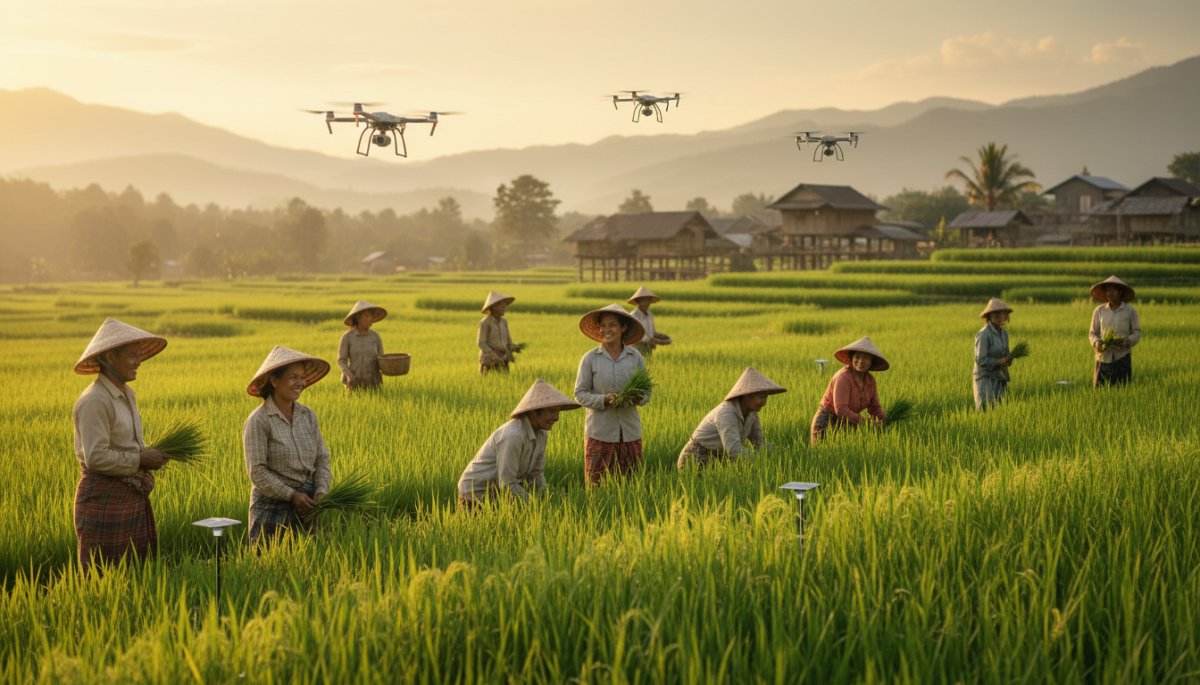
The worsening labor shortage in Southeast Asian agriculture
Southeast Asia is known as one of the world's leading agricultural regions. Blessed with a tropical monsoon climate and fertile delta regions, this area, which has nurtured farming civilization over several thousand years, now faces a serious labor shortage.
In Vietnam, about 43% of agricultural workers are aged 50 or older, and the outflow of young people to cities continues. Similar trends are seen in Thailand and Indonesia, and securing people to carry on farming is an urgent challenge.
Vietnam is an agricultural power, where agriculture accounts for about 12% of GDP and more than 40% of the working population works in agriculture. Annual rice output is about 43.5 million tonnes with the world's second-largest export volume, and coffee Robusta boasts the world's largest output. On the other hand, about 57% of agricultural workers are unskilled, and it faces the structural challenge that 97% of all agricultural workers are small- and medium-scale farmers.
This article introduces in detail eight practical measures for solving the labor shortage in Southeast Asian agriculture, along with actual success stories case studies.
Cutting labor hours by introducing mechanization and automation technology
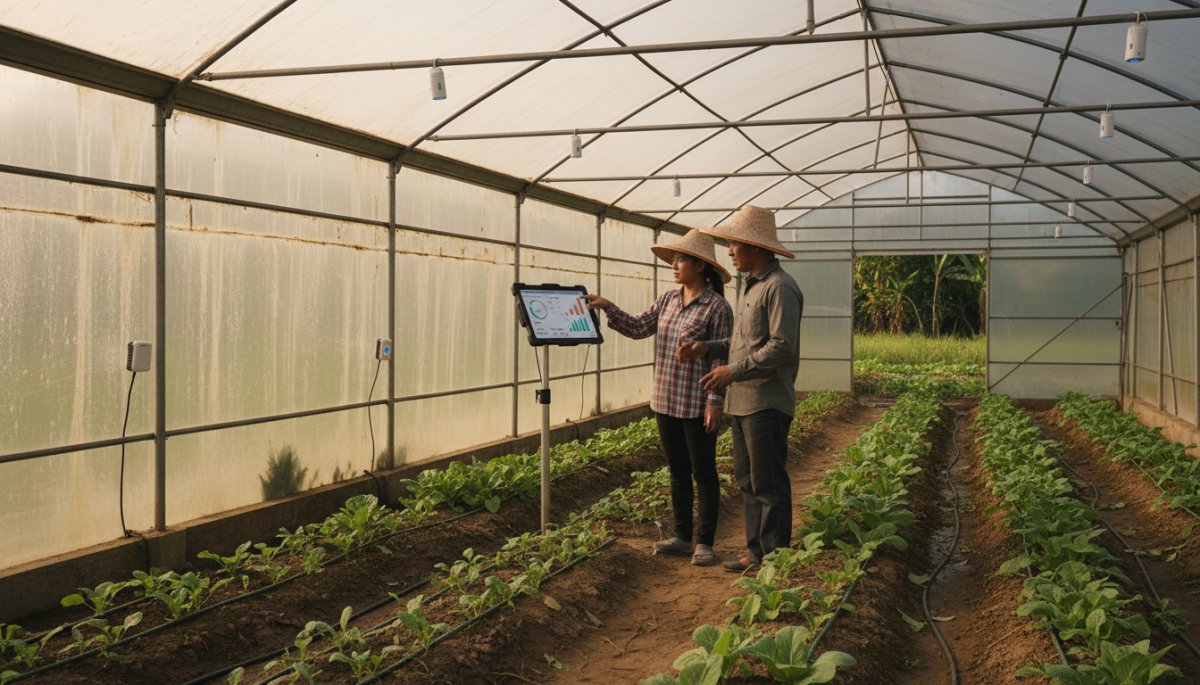
The most direct solution to labor shortages is mechanization. The Vietnamese government has set out its 'Strategy for Sustainable Agriculture and Rural Development to 2030, with a Vision to 2050,' positioning the introduction of smart farming as a national priority.
Various technologies are being demonstrated in many places, such as environmental monitoring with IoT sensors, pesticide spraying by drone, and pest forecasting using AI. Around Bangkok in Thailand, the use of precision agriculture and drones is spreading.
At large farms in the central plain, the adoption of GPS-equipped tractors and automatic rice transplanters is advancing, successfully cutting labor hours. In Vietnam, the average cultivated area per farm is about 0.44 hectares, among the smallest in ASEAN countries, and in some cases it is difficult to introduce large machinery.
This is why small- and medium-sized machinery suited to smallholder farmers and low-cost smart farming models are drawing attention. In Lam Dong Province, automatic irrigation systems have been introduced into small- and medium-scale greenhouses, achieving greater efficiency in vegetable cultivation. In the Mekong Delta, demonstrations of water-saving rice cultivation through the introduction of water management systems are advancing.
Technical cooperation by Japanese companies is also active, with demonstration projects for remote cultivation support solutions being rolled out and technology development that smallholder farmers can also adopt being advanced.
Using foreign workers and making labor more mobile
Another way to secure agricultural labor is to use foreign workers. Within ASEAN, labor is becoming more mobile.
Thai agriculture's In these regions, seasonal workers from Myanmar and Cambodia play an important role. On natural rubber plantations and in orchards, many foreign workers are employed during the harvest season, making up for labor shortages.
However, accepting foreign workers also has challenges. There are many problems to solve, such as the language barrier, cultural differences, improving working conditions, and applying social security systems. The Thai government has repeatedly implemented repayment-grace measures on loans for farmers, but there are also cases where paying appropriate wages to foreign workers squeezes farm management.
The elimination of intra-regional tariffs under the ASEAN Free Trade Area (AFTA) has invigorated the intra-regional distribution of produce and also contributes to balancing labor supply and demand. The inflow of labor from later-joining member countries such as Cambodia and Laos has become a factor supporting agriculture in the more developed countries.
Strengthening cooperatives and promoting collective farming
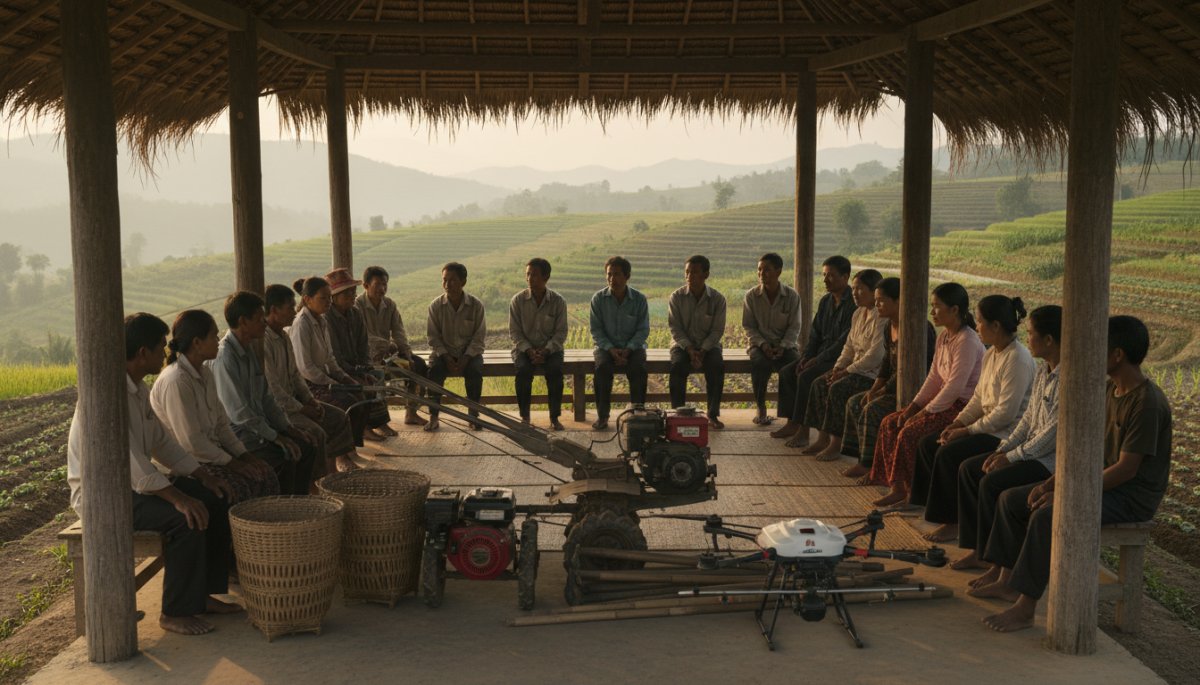
It is difficult for smallholder farmers to cope with labor shortages on their own. What is effective here is strengthening cooperatives cooperatives and promoting collective farming.
In Vietnam, efforts are spreading in which multiple farmers cooperate to jointly purchase and use agricultural machinery. Even if the cultivated area per farm is small, greater efficiency becomes possible when machinery is used collectively.
In Cambodia, the World Bank-supported 'Cambodia Agricultural Sector Diversification Project' is being implemented. This project advances the strengthening of farmer organizations and the building of agricultural value chains, achieving efficient allocation of labor. Centered on the area around Tonle Sap Lake and the Mekong River basin, the production of rice and cassava has been organized through cooperatives, improving productivity.
In Thailand, although the cultivated area per farm averages about 3 hectares, larger than in Vietnam, on the Khorat Plateau in the northeast irrigation facilities are scarce and farm income tends to be unstable. Efforts are being made in which farmers jointly manage water resources through cooperatives to spread risk.
The benefits of collective farming are not limited to sharing labor. Joint shipment of produce raises bargaining power, enabling sales at more favorable prices. It also functions as a venue for technical training and information sharing, improving the overall quality of farm management.
Promoting young people's entry into farming and education programs
To fundamentally solve the shortage of people to carry on farming, the entry of young people is needed. A structural challenge common to Southeast Asian countries is the income gap between the agricultural sector and the industrial and service sectors.
In the CLMV countries (Vietnam, Laos, Myanmar, Cambodia), the gap is widening amid rapid industrialization, and young people migrate to cities seeking jobs in manufacturing and services.
To change this flow, agriculture needs to become an attractive occupation. In Vietnam, agricultural universities and vocational schools are strengthening education programs on smart farming technology and farm management. In Lam Dong Province, entrepreneurship support programs for young farmers are being implemented, and the number of young people aiming to shift to high-value agriculture is increasing.
In Thailand, interest in organic and sustainable agriculture is rising, and environmentally conscious young people are building new agribusiness models. Jasmine rice's organic cultivation branding has earned a high reputation in international markets and contributes to raising young farmers' incomes.
In Indonesia, agricultural startup companies are emerging, presenting a new way of farming that uses technology. Palm oil Efforts toward sustainability in that industry are also a factor drawing young people's interest.
Using smart farming and digital technology
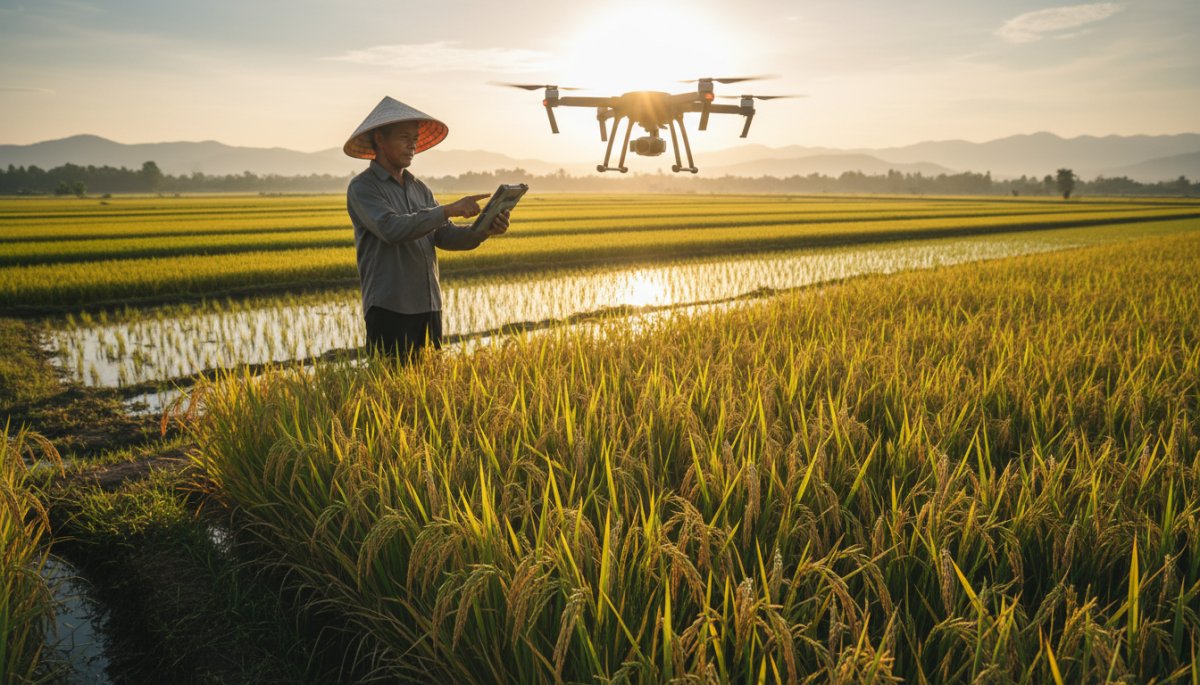
Digital technology not only makes up for labor shortages but also improves agricultural productivity. In Vietnam's Mekong Delta, water-saving rice cultivation through the introduction of water management systems is being demonstrated.
IoT sensors monitor soil moisture and salinity in real time and notify farmers of the optimal irrigation timing. This achieves both reduced labor hours and higher yields at the same time.
Pesticide spraying by drone is a technology that lets a small number of people manage vast farmland. At large Thai farms, there are reports that using drones greatly reduced working time compared with conventional manual spraying. In addition, pest-forecasting systems using AI help prevent damage before it occurs and contribute to reducing pesticide use.
The Philippines faces the challenge of a high risk of severe crop damage from nearly twenty typhoons approaching or making landfall each year on average. Disaster-forecasting systems combining weather data and AI have been developed, making it possible for farmers to take measures in advance.
Remote cultivation support solutions by Japanese companies are also drawing attention. Through smartphone apps, experts provide cultivation advice to farmers in remote locations, achieving greater efficiency in technical guidance.
Adding high value and branding of produce
To solve labor shortages, it is also important to generate high returns with fewer people. The Vietnamese government has set a goal of entering the world's top 15 in agriculture and food processing by 2030, and is promoting a policy built on three pillars: attracting investment in processing facilities, developing cold chains, and strengthening branding.
By raising the added value of produce, it aims for a structure where high income can be earned even with little labor. Primary processing techniques such as drying and powdering are the key.
Tropical produce spoils quickly and is difficult to transport over long distances or store for long periods as is, but drying or powdering it improves shelf life and also cuts logistics costs. Dried vegetables, dried fruit, and freeze-dried products are seeing growing demand in developed-country markets amid rising health consciousness.
Thailand's jasmine rice is a good example of successful branding. It has earned a high reputation in international markets and trades at higher prices than ordinary rice. In Vietnam too, the branding branding of coffee is being advanced, and a shift is underway from merely exporting green beans to exporting roasted, processed finished products.
In Indonesia, sustainable Palm oil efforts to raise competitiveness in international markets by obtaining palm oil certification (RSPO, ISPO) are advancing. Environmentally conscious production methods enable sales at premium prices and contribute to raising farmers' incomes.
Promoting international cooperation and technology transfer
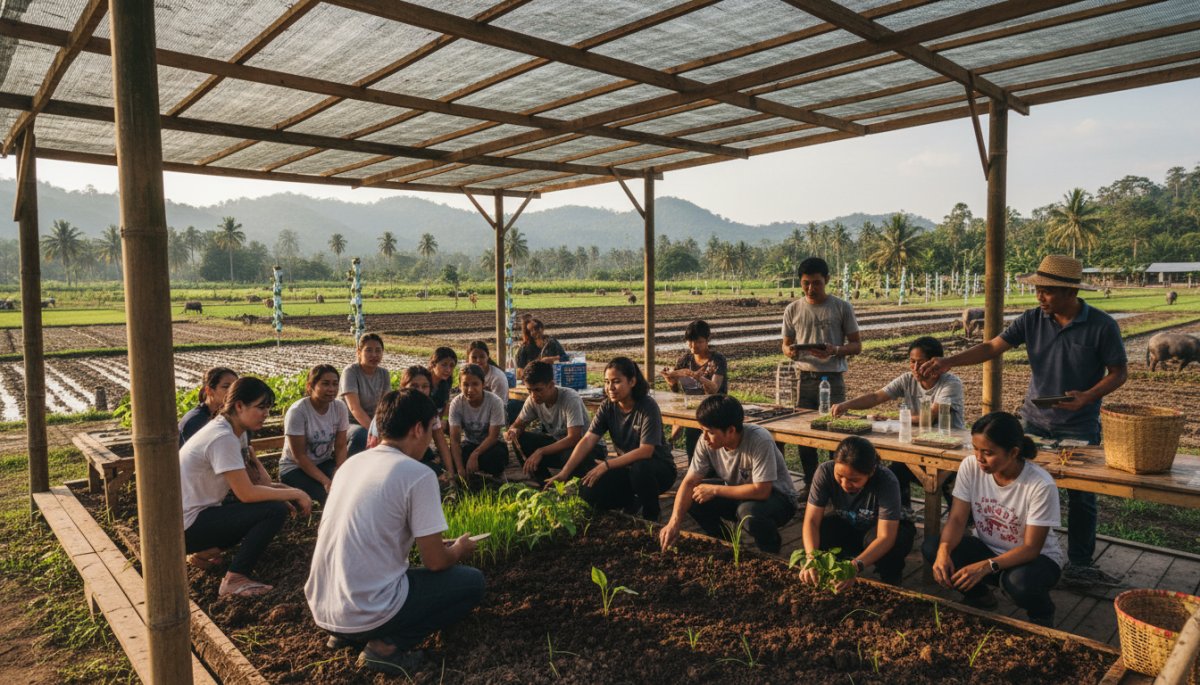
The labor shortage in Southeast Asian agriculture is not a problem that any one country can solve alone. The 'Japan-ASEAN Midori Cooperation Plan,' adopted at the Japan-ASEAN agriculture and forestry ministers' meeting in May 2023, is a comprehensive cooperation framework aimed at building sustainable agriculture and food systems in the Asian monsoon region.
Japan positions ASEAN as its most important partner for the international rollout of the environmental-impact-reducing technologies set out in its 'Strategy for Sustainable Food Systems (MIDORI).' Specifically, the pillars are the transfer of precision agriculture technology, support for promoting organic farming, the introduction of paddy-field management techniques to reduce greenhouse gas emissions, and support for upgrading agricultural value chains.
Japan's strength lies in having technology and know-how suited to small- and medium-scale farmers. Unlike the smart farming solutions of the Netherlands or South Korea, which presuppose large-scale agriculture, Japanese agricultural technology is considered highly likely to fit the realities of Southeast Asia's smallholder farmers.
The International Rice Research Institute (IRRI), based in Los Banos in the Philippines, is advancing the development of the flood-tolerant variety 'Sub1' and salt-tolerant varieties, and these varieties are spreading widely across Vietnam, Bangladesh, India, and other areas. Developing climate-resilient varieties is important for securing stable yields even amid labor shortages.
The World Bank and the Asian Development Bank are also supporting the agricultural modernization of Southeast Asian countries. In later-developing countries such as Cambodia, Myanmar, and Laos, agriculture still accounts for a high share of GDP and employment, and technology transfer through international cooperation is a key to economic development.
Shifting to sustainable agriculture and environmentally conscious farming methods
Solving labor shortages and protecting the environment can be achieved at the same time. In Southeast Asia, the shift from conventional chemical farming to organic and sustainable agriculture is emerging as a policy issue for each country's government.
Organic farming restores soil health by reducing the use of chemical fertilizers and pesticides, maintaining long-term productivity. Environmentally conscious farming methods also enable premium prices in international markets, so high returns can be earned even with little labor.
Thailand is one of the countries in Southeast Asia where the institutional framework for organic farming is most developed, operating a certification system under the 'Thai Organic Agriculture Standard.' The Thai government positions organic rice exports as a growth strategy, and jasmine rice's organic cultivation is actively promoted. Organic-certified produce trades at high prices in the EU and Japanese markets, contributing to raising farmers' incomes.
In Vietnam too, the Ministry of Agriculture and Rural Development has set the expansion of organic farming as a policy goal. In leading regions such as Lam Dong Province, organic vegetable cultivation is spreading, becoming a model case for high-value agriculture.
In Cambodia and Laos, there are moves to make organic farming a differentiation strategy in international markets, taking advantage of the characteristic that their use of chemical pesticides and fertilizers was low to begin with. Low-environmental-impact agriculture reduces labor-intensive work and enables efficient farm management.
In Indonesia, in response to international criticism of environmental destruction in the palm oil industry, the spread of sustainable palm oil certification (RSPO, ISPO) is being advanced. Obtaining certification raises brand value in international markets, and a structure is being built that can maintain competitiveness even amid labor shortages.
Summary: Eight measures that open up the future of Southeast Asian agriculture
The labor shortage in Southeast Asian agriculture is a serious challenge. However, by combining the eight measures introduced in this article, mechanization and automation, using foreign workers, strengthening cooperatives, promoting young people's entry, advancing smart farming, adding high value, international cooperation, and shifting to sustainable agriculture, a path to a solution comes into view.
Vietnam is an agricultural powerhouse whose total agriculture, forestry, and fishery exports reached about US$53 billion in 2023, accounting for more than 15% of the country's total exports. Thailand as the 'kitchen of the world' and Indonesia as ASEAN's largest agricultural producer each confront the common challenge of labor shortages while making the most of their own strengths.
Cooperation with Japanese companies and international organizations also plays an important role. The 'Japan-ASEAN Midori Cooperation Plan,' adopted at the Japan-ASEAN agriculture and forestry ministers' meeting in May 2023, will be a framework supporting the future of Southeast Asian agriculture through technology transfer and the promotion of sustainable agriculture.
The shortage of people to carry on farming is not merely a labor problem. It is also a trigger prompting a qualitative transformation of agriculture. From quantity to quality, from production to economy. Southeast Asian agriculture is now in the midst of great change.
You May Also Like
- What is the automation of Southeast Asian agriculture? Eight latest technologies that solve labor shortages, and how to adopt them
- How to Make Southeast Asian Agriculture More Efficient? 9 Practical Methods for Boosting Productivity
- Why Is AI Adoption Advancing in Southeast Asian Agriculture? 7 Methods for Boosting Productivity