The current state and structural features of Vietnamese agriculture
Vietnam is one of Southeast Asia's leading agricultural countries, with a population of about 100 million.
Agriculture, forestry, and fisheries make up around 12% of GDP, but on an employment basis about 30% still work in agriculture-related jobs, so even today, with industrialization advanced, agriculture can be called the very foundation of society. Before the economic opening ushered in by the 1986 Doi Moi policy reforms, the country operated a collective farming system, but afterward the individual allocation of land-use rights and the introduction of a market economy sharply raised productivity.
Since the 1990s, rice export have placed the country among the world's leaders, followed by coffee, pepper, Cashew nuts, seafood, and other items, which have grown into major export products. Coffee in particular boasts the world's second-largest export volume, most of which is Robusta of organic jasmine rice.
An agricultural structure supported by smallholders
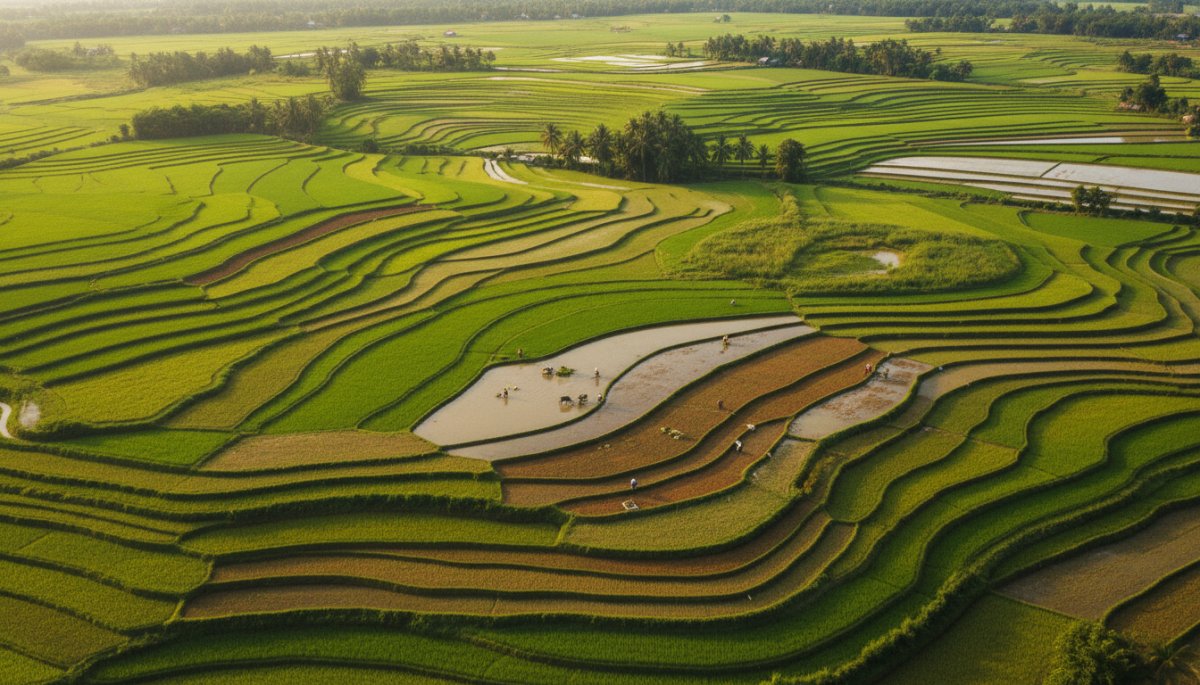
The biggest feature of Vietnamese agriculture is its extremely small-scale farmer structure. The average cultivated area is under 1 ha for the great majority, and many farmers hold only about 0.3 to 0.5 ha. Because of this, variation in quality is large, and it is a structure that makes standardization and price negotiation difficult.
Because small-scale farmers are dispersed, collectors (brokers) hold the power to set prices, and farmers have almost no bargaining power. Organized aggregation like Japan's agricultural-cooperative model is weak, forming a structure in which farmers' incomes are hard to raise.
An export model centered on primary commodities
Rice, coffee, pepper, seafood, and the like are mostly exported as raw materials or in lightly processed form, and in many cases the added value is captured on the overseas side. Processing infrastructure is limited, and secondary processing such as drying, milling, and extraction is still developing. As a result, large volumes of out-of-spec produce and surplus crops are generated.
Regional agricultural characteristics and major crops
Vietnam has clear crop specialization by region.
The Mekong Delta: The Country's Largest Granary
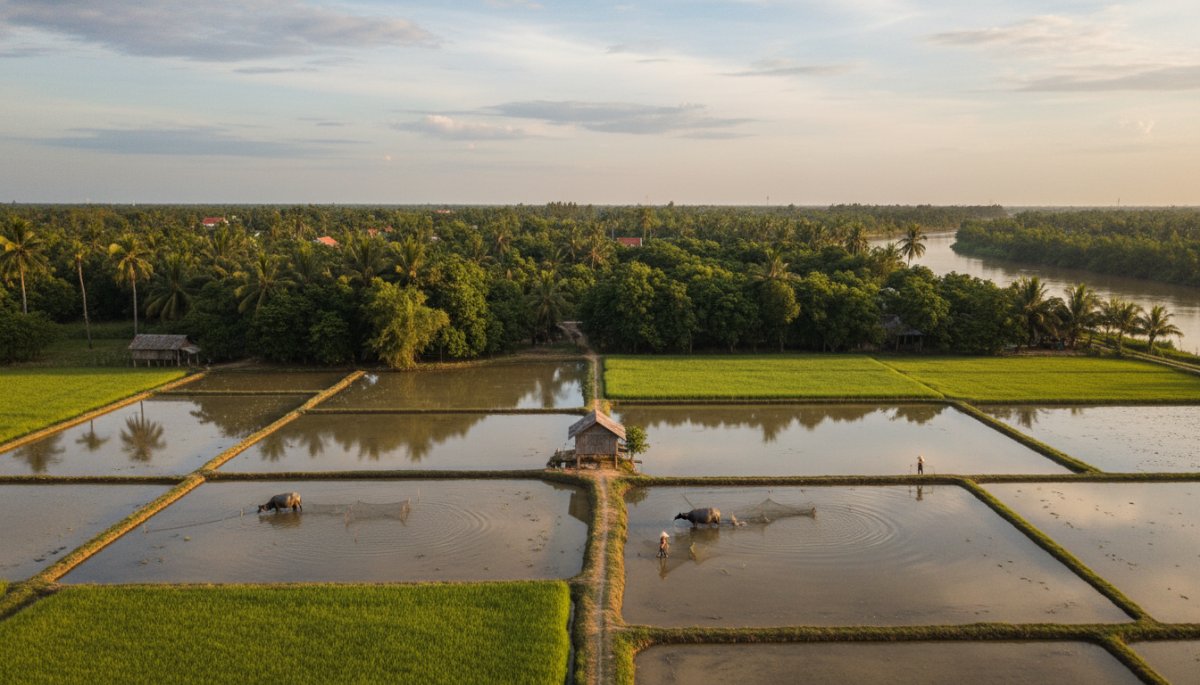
The Mekong Delta in the south is the country's largest granary, accounting for about half of Vietnam's rice output and nearly 90% of its export rice. The Mekong River's alluvial soil and abundant water allow two to three crops a year, giving it land productivity among the highest in the world.
Here, besides rice, there are tropical fruit trees such as coconut, mango, and dragon fruit, as well as freshwater fish and shrimp farming shrimp farming, are also thriving. In recent years, salt damage has made rice monoculture difficult, and integrated management such as "rice + shrimp" and "conversion to fruit trees" is increasing.
The Central Highlands: The Core Region for Export Crops
The Central Highlands (Dak Lak Province and others) is the core region for export crops, producing coffee, black pepper, Cashew nuts is the main production area for these. The volcanic soil and the climatic conditions at 500-800 m elevation suit these crops. However, its heavy dependence on a single crop also leaves it vulnerable to the direct effects of international market prices and drought.
The Red River Delta: peri-urban agriculture
The Red River Delta in the north is a peri-urban farming zone that includes the capital, Hanoi, and is centered on intensive cultivation of leafy and fruiting vegetables in addition to rice. It is characterized by a higher share going to domestic consumption than to export.
Aquaculture: a national strategic industry
In the Mekong Delta, shrimp farming and pangasius (catfish) farming are carried out on a large scale, forming a pillar of exports to Japan, the EU, and the United States. A value chain linked to frozen-processing plants has been built, and a model of earning foreign currency through "production plus simple processing" has been established.
The rise of Vietnamese agritech startups
In Prime Minister's Decision No. 844 of 2016, the Vietnamese government set out the "Project on Supporting the Startup Ecosystem to 2025," with goals including the creation of 2,000 startup projects and 600 startups by 2025.
Vietnam's startup investment in 2018 expanded to US$889 million, roughly triple the 2017 figure (US$291 million). Vietnam is a latecomer as a startup base, but it is also said to be the only ASEAN country with both a market and IT talent in place, and it is drawing attention.

FoodMap: an e-commerce platform connecting farmers and end users
FoodMap, a startup in Ho Chi Minh City in the south, aims to solve the challenges facing Vietnam's agricultural sector, such as improving farmers' livelihoods and promoting the sale of farm produce.
The company runs an e-commerce platform, foodmap.asia, that connects farmers with end users (consumers, retailers, restaurants, and the like), where producers, centered on Vietnam's especially small and medium-sized farmers, sell their own products directly to domestic end users such as general consumers and retailers.
This platform has adopted a traceability system, and by making production information about products transparent it lets consumers easily check the growing region, raw materials, and producer of a product. It has now come to work with more than 2,000 farmers and over 200 farm-produce brands across all 63 provinces and cities of Vietnam.
As of September 2023, FoodMap had reached US$4.4 million in total funding, with investment from Vulpes Ventures, Beenext, Ascend Vietnam Ventures, and Wavemaker Partners. It also has multiple awards at home and abroad, including winning the Best Vietnam AgriTech Startup category at the "Rice Bowl Startup Awards in Malaysia" in 2019.
Source
JETRO, "FoodMap - supporting farmers via e-commerce and more: a Vietnamese startup to watch"
Created based on the above (2024).
Trends in overseas agritech startups entering Vietnam
Entry by agritech startups from overseas into the Vietnamese market is also becoming more active.
GRAFT Challenge Vietnam 2021
At the "GRAFT Challenge Vietnam 2021," held as part of the Aus4Innovation program through which the Australian government strategically cooperates with Vietnam's Ministry of Science and Technology, entries came from 16 countries including the United States, Israel, Australia, India, and Thailand, aiming to solve Vietnam's pressing agri-food challenges, and 9 companies were selected as finalists.
The selected companies included AgNext Technologies (India), which develops an AI-driven SaaS platform that digitizes food quality assessment; JalaTech (Indonesia), which provides a shrimp-farm management platform; and Sufresca (Israel), which extends the shelf life of fresh products at room temperature with a bio-based edible coating.
Source
Science Portal Asia Pacific, "Nine overseas companies selected for a project to solve Vietnam's agri-food problems, with support from the Australian government"
created based on the above (2021)

Entry opportunities for Japanese companies
"J-Star Global Growth for AgriTech" (J-StarX), an overseas growth-support program in the agritech field jointly run by JETRO and Boab AI, provides Japanese startups with opportunities to directly engage with the cutting-edge agritech advancing in Australia.
In this program, companies can present to venture capitalists, corporations, and agribusiness partners, and visit farms and research institutions that have adopted robotics, AI, precision agriculture, and sustainability solutions.
Source
Green Carbon Inc., "An overseas growth-support program in the agritech field by JETRO and Boab AI"
Compiled from (2025)
Challenges and opportunities in Vietnam's agritech market
Structural challenges
The biggest problem facing Vietnamese agriculture is dependence on middlemen. Because smallholders are dispersed, collection traders (brokers) hold the power to set prices, and farmers have almost no bargaining power. Processing infrastructure is also limited, and secondary processing such as drying, milling, and extraction is still developing.
Environmental challenges
Saltwater damage in the Mekong Delta is worsening. Due to sea-level rise and the effects of upstream dams, in the dry season saltwater pushes inland, and areas where rice can no longer be grown are increasing. As a result, structural changes are under way, such as switching to salt-tolerant varieties, converting to fruit trees, converting to aquaculture, and expanding reliance on groundwater.
Progress in technology adoption
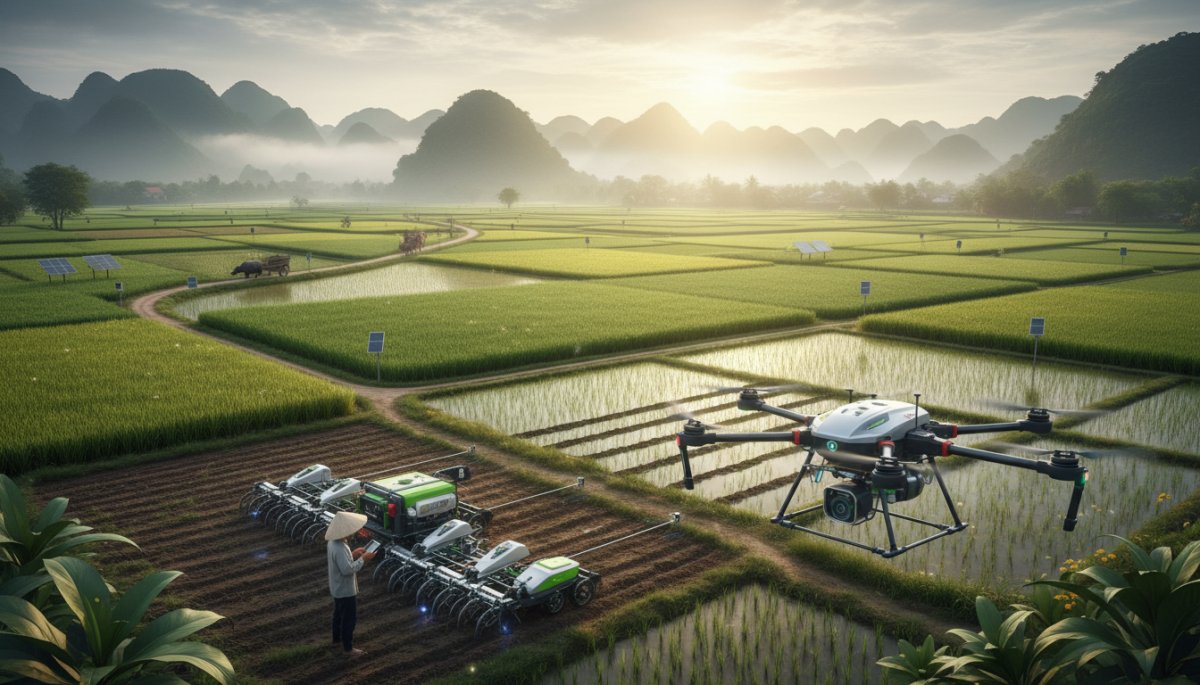
In recent years there has been change, too. Against the backdrop of tighter regulations in destination countries, the acquisition of international certifications such as GlobalG.A.P., residual-pesticide management, and traceability readiness are advancing. The adoption of smart agriculture, such as drone spraying and IoT irrigation, has also begun at some large farms. However, the spread is limited, and the great majority of smallholders still farm mainly by hand.
Opportunities for Japanese companies
From a Japanese-company perspective, Vietnamese agriculture holds great potential in the following respects.
- High raw-material supply capacity for fruit, coffee, spices, and more
- Weak processing steps, leaving ample room for drying, milling, and conversion into raw materials
- Large volumes of out-of-spec produce exist
In other words, the current state of being stuck at primary commodities is a structure that fits very well with a Japanese-style processing and high-value-added model. There is still much room to expand into dried vegetables, fruit powders, extracted ingredients, functional raw materials, and the like.
Entry strategy for Vietnam's agritech market
Developing solutions for smallholders
In Vietnam, where smallholders with an average cultivated area under 1 ha make up the majority, low-cost and easy-to-adopt solutions are in demand. Technologies that keep the initial investment down, such as smartphone-based applications, simple sensors, and cloud-based management systems, are effective.
Support for traceability and branding
To respond to tighter regulations in destination countries, adopting traceability systems is an urgent need. Services that, like FoodMap, combine making production information transparent with marketing activities that raise product value are expected to be in even greater demand going forward.
Investment in processing infrastructure
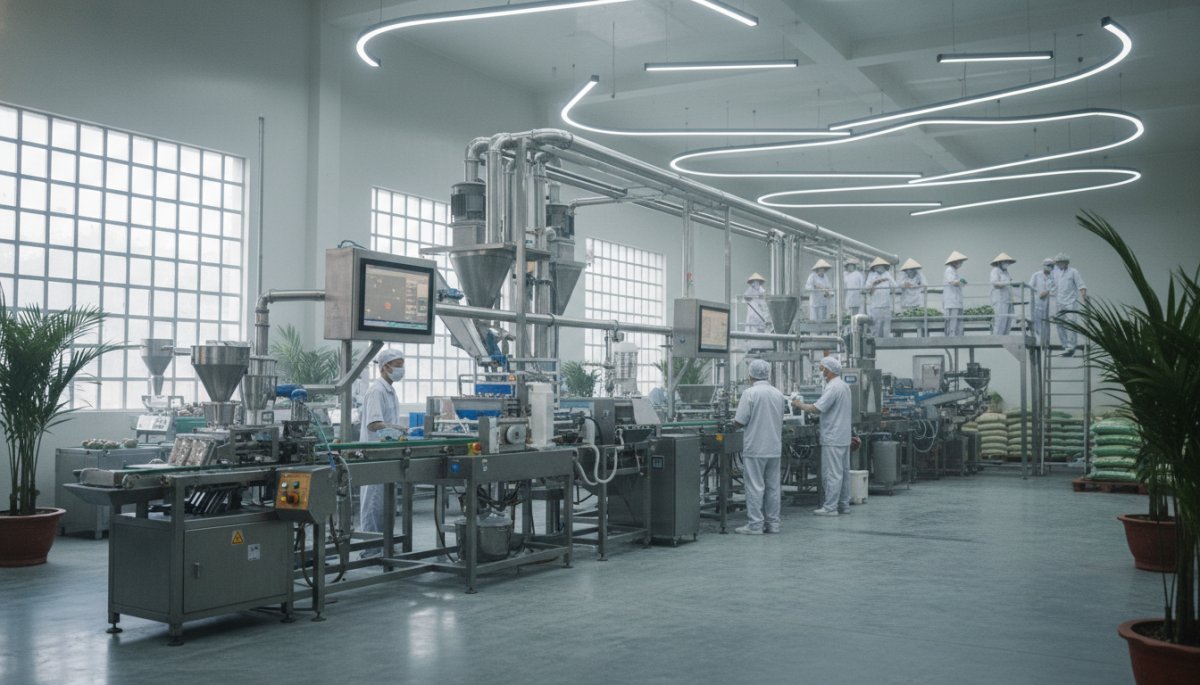
Vietnam generates large volumes of out-of-spec produce and surplus crops. By introducing secondary processing techniques such as drying, milling, and extraction, you can add value and reduce food loss. The processing know-how Japanese companies possess becomes a major competitive advantage in the Vietnamese market.
Collaboration with local partners
Entering the Vietnamese market requires working with local farm groups, government agencies, and existing startups. Using support programs such as those from JETRO and Boab AI can accelerate building a local network and understanding the market.
Addressing environmental challenges
As measures against saltwater damage in the Mekong Delta, solutions that address environmental challenges, such as developing salt-tolerant varieties, soil-improvement techniques, and water-management systems, are easier to get government support for and have a large social impact.
Summary: the outlook for Vietnam's agritech market
Vietnam has a population of about 100 million, with roughly 30% of its workforce engaged in agriculture-related work, making it one of Southeast Asia's leading agricultural nations.
While it faces structural challenges such as a smallholder structure, an export model centered on primary commodities, and a lack of processing infrastructure, these very challenges present a major opportunity for agritech startups. The rise of local startups such as FoodMap success stories, and the active entry of overseas companies, demonstrate the growth potential of Vietnam's agritech market.
For Japanese companies, Vietnam is an attractive market with high raw-material supply capacity and ample room to introduce processing technology. There are diverse entry opportunities, such as low-cost solutions for smallholders, traceability systems, investment in processing infrastructure, and addressing environmental challenges.
By using support programs such as those from JETRO and Boab AI and deepening collaboration with local partners, you can raise the probability of success in Vietnam's agritech market. From 2026 onward, as Vietnam evolves from a "raw-material supplier" into an "agricultural nation with processing and brands," Japanese companies' technology and know-how are expected to play an important role.
Consider entering Vietnam's agritech market right now, and lead Southeast Asia's agricultural innovation.

