What is the Doi Moi policy? A historic turning point for Vietnam
Doi Moi (Đổi Mới) is a word meaning "renovation" in Vietnamese. Adopted in December 1986 at the 6th National Congress of the Communist Party of Vietnam, this economic reform policy greatly transformed Vietnam's economic structure.
Until then, Vietnam had faced economic stagnation under a centralized socialist economic system. After the reunification of North and South in 1976, the government pursued a heavy-industrialization line, but the results were limited. Under the Second Five-Year Plan (1976–1980), although the growth-rate target for produced national income was set at 13.0–14.0%, the actual result stayed at only 0.4%. Growth stagnated in both industry and agriculture, and the people's lives were impoverished.
In 1986, when Party General Secretary Le Duan, who had pursued a pro-Soviet line, died, the newly installed General Secretary Nguyen Van Linh declared the Doi Moi line. Behind this policy shift were changes in the international situation as well, such as the emergence of the Gorbachev administration in the Soviet Union and the advance of perestroika, and the improvement of Sino-Soviet relations.
The Doi Moi policy was a reform that introduced a market economy while maintaining the one-party socialist system. Specifically, it set out "four reductions"—①curbing currency expansion, ②calming high prices, ③relieving hardship in living, and ④narrowing the fiscal deficit—and promoted increased food production centered on rice, an emphasis on light industry centered on consumer goods, the encouragement of exports, and opening the door to foreign companies.
Source Economic Planning Agency, "Heisei 4 Annual World Economic Report, Chapter 3: Economic Reform in Transition Economies and Integration into the World Economy"(1992), adapted
Vietnamese agriculture before the Doi Moi policy—an era of stagnation and crisis
To understand the significance of the Doi Moi policy, one needs to know the state of Vietnamese agriculture before it.
Socialization after reunification of North and South
After the reunification of North and South in 1976, the Vietnamese government introduced a centralized socialist economic system in the South as well. It tightened economic control over the South, which had until then been under a liberal economic system, and promoted the collectivization of agriculture. However, this policy resulted in reducing farmers' motivation to produce.
Farmers were obliged to deliver their harvests to the state at low prices, and free sales were restricted. Under the heavy-industry-first policy, a mechanism was created to feed low-priced raw materials from the agricultural sector into the industrial sector, but investment in agriculture was insufficient and productivity stagnated.
The deepening of food shortages
In the early 1980s, Vietnam faced food shortages. Rice output could not meet domestic demand, and the 1980 rice output stayed at 11.65 million tonnes.
The government attempted partial reform in 1981. It allowed farmers to freely dispose of the portion exceeding their contracted quantity, and raised the rice procurement price fivefold at a stroke. Through this measure, rice output increased to 15.89 million tonnes by 1985, but it did not amount to a fundamental solution.
Fiscal deficits and inflation
The failure of economic policy led to an expansion of the fiscal deficit. Price-difference subsidies to protect state-owned enterprises squeezed the national finances, and the 1985 fiscal deficit reached 17.1% of GDP. Because about 60% of this deficit was covered by borrowing from the central bank, the money supply surged, and in 1986 inflation occurred with a consumer price increase exceeding 700%.
Amid such circumstances, Vietnam was forced into drastic economic reform.
Source Economic Planning Agency, "Heisei 4 Annual World Economic Report, Chapter 3: Economic Reform in Transition Economies and Integration into the World Economy"(1992), adapted
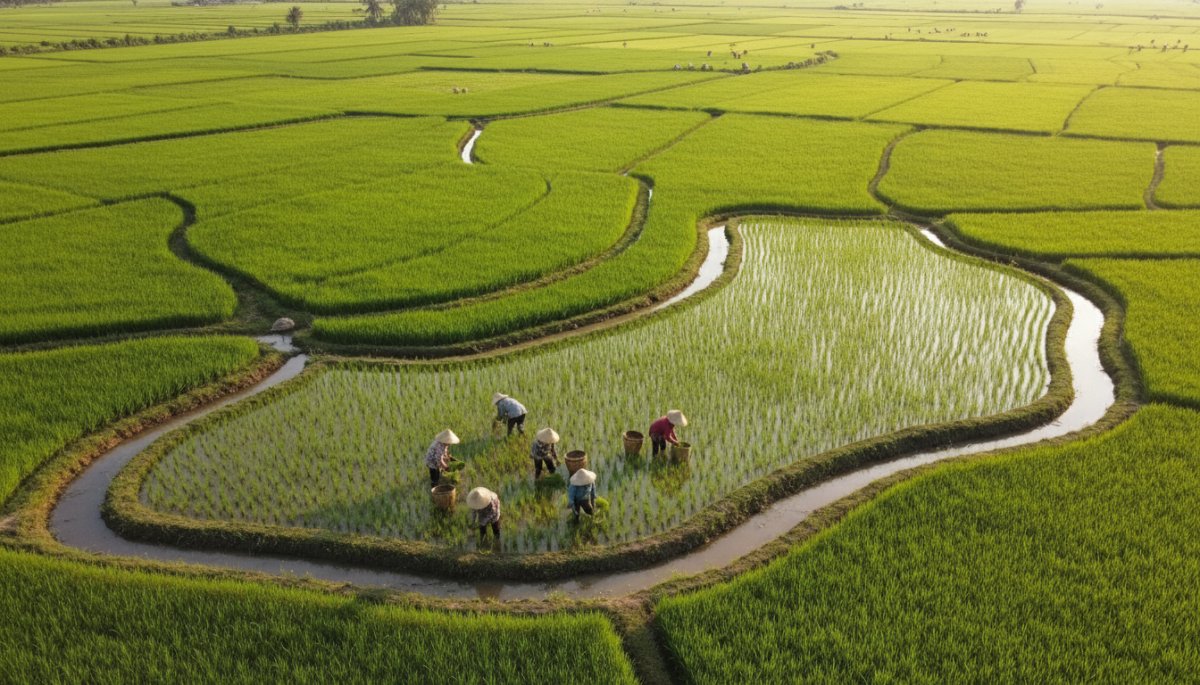
The seven impacts the Doi Moi policy had on Vietnamese agriculture
Impact ①: granting land-use rights to individual farmers
One of the important reforms of the Doi Moi policy was granting land-use rights to individual farmers. Breaking away from the previous collective-farming system, farmers became able to carry out production activities independently.
Through this reform, farmers' motivation to produce improved. As their own efforts came to be directly tied to income, agricultural production expanded. The average farmland area of a Vietnamese farm is about 0.44 hectares, among the smallest in ASEAN countries, but even on a small scale, independent management became possible.
Impact ②: the shift to a rice-exporting power
The results of the Doi Moi policy appeared in a short time. In 1989, Vietnam turned into a net rice exporter for the first time. It was a change in which a country that had been suffering from food shortages became an exporter within a few years.
Currently, Vietnam's annual rice output is about 43.5 million tonnes, and its export volume boasts second place in the world. The Mekong Delta has become one of the world's foremost production zones, handling more than half of the country's rice output, and most of the rice for export is shipped from this region.
Impact ③: the introduction of a market economy and price liberalization
The Doi Moi policy promoted the marketization of farm produce. From 1987 to 1989, a series of liberalization policies was implemented to convert official prices into market prices.
Until then, there had been a large gap between market prices and the fixed prices set by the state, and subsidies to cover that gap squeezed the national finances. Through price liberalization, this gap was resolved, and market mechanisms came to function. Farmers became able to choose what to produce in response to market demand, and agricultural diversification advanced.
Impact ④: the growth of export crops such as coffee and cashew nuts
Through the Doi Moi policy, farm products other than rice also grew. Especially notable was coffee.
Centered on the central highlands (Tay Nguyen), coffee growing expanded. Vietnam became the world's second-largest in coffee output and, especially in Robusta the world's largest producing country. In addition, output of Cashew nuts and black pepper ranks first in the world.
In 2023, total exports of agriculture, forestry, and fisheries reached about US$53 billion, coming to account for more than 15% of the country's total exports. The Doi Moi policy transformed Vietnam into an agricultural-export power.
Impact ⑤: the introduction of foreign capital and the modernization of agricultural technology
The Doi Moi policy also included opening the door to foreign companies. Through this, investment and technology from overseas came to flow into the agricultural field as well.
Modernization of agricultural technology advanced, including the development of irrigation infrastructure, the spread of high-yield varieties, and the introduction of farm machinery. The flood-tolerant variety "Sub1" and salt-tolerant varieties developed by the International Rice Research Institute (IRRI) spread in Vietnam, and resilience to climate change also improved.
Impact ⑥: the development of the fisheries industry—the success of shrimp farming
The Doi Moi policy also affected the fisheries industry. In particular, shrimp farming is one of the success stories of Vietnamese agriculture.
Vietnam accounts for third place in the world in shrimp output and second in export volume. Centered on the Mekong Delta, shrimp farming is flourishing, and the export value of fishery products reaches about US$9 billion a year. Japan, the United States, and the EU are the main export destinations, making it an important source of foreign-currency earnings for Vietnam.
Impact ⑦: changes in the agricultural structure and the surfacing of new challenges
Through the Doi Moi policy, Vietnamese agriculture expanded in quantity, but at the same time new challenges surfaced.
Agriculture accounts for about 12% of GDP and employs more than 40% of the working population, but 97% of all agricultural workers are small- and mid-scale farmers, about 57% of agricultural laborers are unskilled, and those aged 50 and over reach about 43%. The outflow of young people to urban areas continues, and a shortage of farming successors and aging are advancing.
In addition, the bulk of farm exports are unprocessed primary products, and the low added value is a challenge. Because the cold chain (low-temperature logistics) is underdeveloped, post-harvest losses are also large, squeezing the profitability of agriculture as a whole.
Source Policy Research Institute, Ministry of Agriculture, Forestry and Fisheries, "Cross-cutting and Comprehensive Agricultural Strategies of Major Countries, Research Material No. 7, Chapter 2: Vietnam—Policies on Rice and Farmland and Their Background"(March 2018), adapted
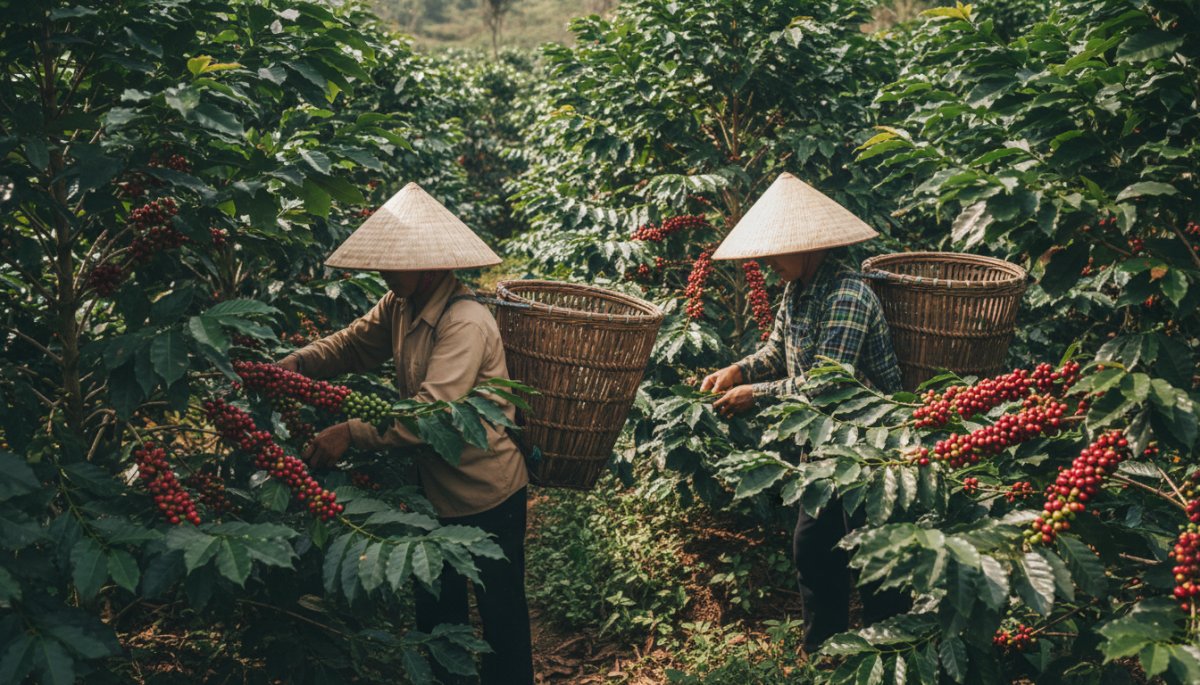
Modern Vietnamese agriculture after the Doi Moi policy—challenges and the outlook for the future
A transition period from quantity to quality
Now, about forty years after Doi Moi, Vietnamese agriculture is entering a new transition period. The benefits of quantitative expansion have plateaued, and a shift from "agricultural production" to an "agricultural economy"—that is, from quantity to quality—is called for.
The Vietnamese government has set out a "Strategy for Sustainable Agriculture and Rural Development to 2030, with a Vision to 2050," positioning the introduction of smart agriculture as a national priority. Demonstrations of various technologies are advancing, such as environmental monitoring with IoT sensors, pesticide spraying by drone, and AI-based pest and disease forecasting.
Responding to Climate Change
One of the challenges facing Vietnamese agriculture is climate change. The Mekong Delta is low-lying, and the risks of saltwater intrusion and flooding from rising sea levels increase year by year.
Development of salt-tolerant and drought-tolerant rice varieties, improvement of water-management technology, and development of agricultural insurance systems are being advanced. The need to review the very siting strategy of agriculture has also been pointed out.
Efforts to raise added value
The Vietnamese government has set a goal of entering the world's top 15 in agriculture and food processing by 2030, promoting the attraction of investment into processing facilities, development of the cold chain, and strengthening of branding.
Primary-processing technologies such as drying and powdering are drawing attention. Tropical farm produce spoils quickly, but drying and powdering raise shelf life and can also reduce logistics costs. Dried vegetables, dried fruit, and freeze-dried products are seeing expanding demand in advanced-country markets against a backdrop of rising health consciousness, and they are becoming a means of delivering products with added value.
Cooperation with Japan—the "Japan-ASEAN Midori Cooperation Plan"
The "Japan-ASEAN Midori (Green) Cooperation Plan," adopted at the Japan-ASEAN Agriculture and Forestry Ministers' Meeting in May 2023, is a comprehensive cooperation framework for building sustainable agriculture and food systems in the Asian monsoon region.
Japan positions the international rollout of the environmental-impact-reduction technologies set out in its "Strategy for Sustainable Food Systems (MIDORI)" with ASEAN as its most important partner. Transfer of precision-agriculture technology, support for promoting organic agriculture, introduction of paddy-management technology to reduce greenhouse-gas emissions, and support for upgrading farm-produce value chains are being advanced.
Japan's strength lies in having technologies and know-how suited to small- and mid-scale farmers. There is a high possibility of a fit with the realities of Vietnam's small-scale farmers, and expanded cooperation is expected going forward.
Source Development Bank of Japan, Research Institute of Capital Formation, "Economic and Management Research Vol. 27 No. 4: Vietnam after the Introduction of the Doi Moi (Renovation) Policy"(March 2007), adapted
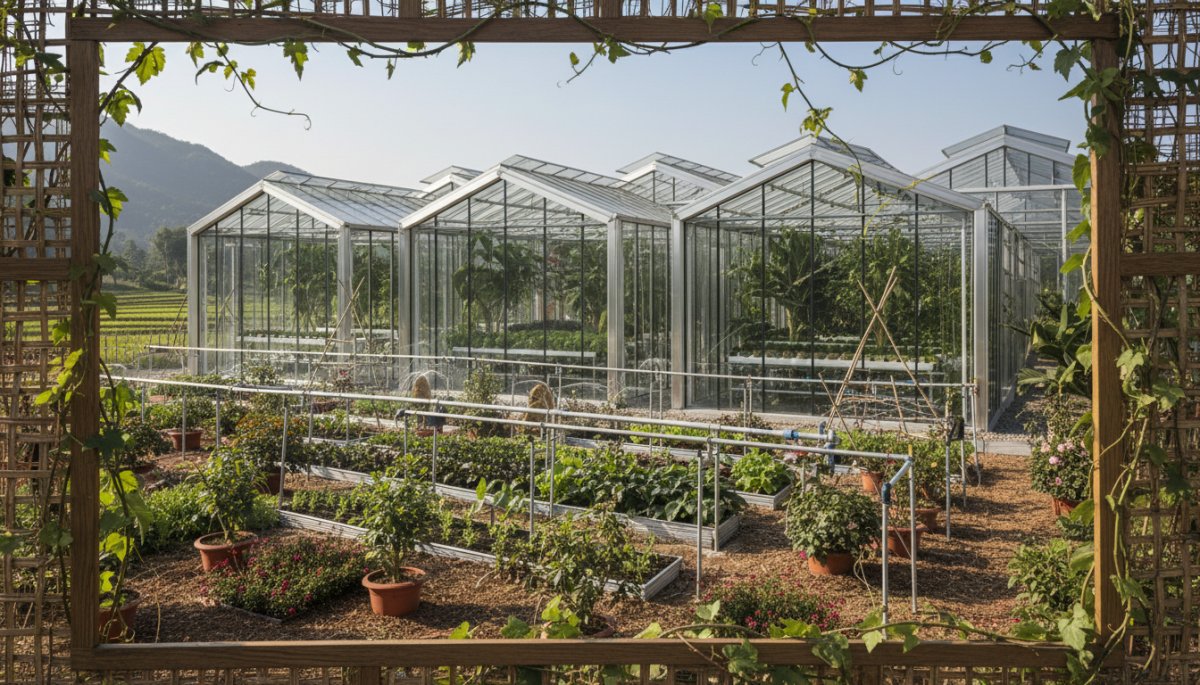
Summary—the power of reform shown by the Doi Moi policy
The Doi Moi policy greatly transformed Vietnamese agriculture. From the start of reform in 1986, it turned into a net rice exporter within a few years, and is now one of the world's foremost agricultural-export powers.
The impacts the Doi Moi policy had on agriculture were large, including granting land-use rights to individual farmers, the introduction of a market economy, price liberalization, and the introduction of foreign capital. It came to boast world-class production and export volumes for diverse farm products such as rice, coffee, cashew nuts, and shrimp.
However, challenges also remain. There are no shortage of problems to solve, including low added value, an underdeveloped cold chain, the low productivity and aging of small-scale farmers, and responding to climate change.
Even so, the power of reform shown by the Doi Moi policy will be an important guide for the future development of Vietnamese agriculture. New reforms are being advanced, including the shift from quantity to quality, the introduction of smart agriculture, and the transition to sustainable agriculture.
The future of Vietnamese agriculture will be opened up by layering further innovation on the foundation built by the Doi Moi policy.
If you are interested in the development of Vietnamese agriculture, please check the latest trends and explore the possibilities of business opportunities and cooperation. As one of Southeast Asia's agricultural power Vietnam will continue to play an important role in supporting the world's food supply.
You May Also Like
- Vietnam's main crop items and cultivation techniques | Production strategies for coffee, rice and shrimp
- Asian Agricultural Powers Ranking 2026: The Strength of the Top 10 Countries Seen from Output and Export Value
- What Is Vietnam's Rice Export Volume? World No. 3 Strength and 7 Strategies Driving Export Growth