What the history of Southeast Asian agriculture suggests for the present
Southeast Asian agriculture has achieved its own distinctive development over several thousand years of history.
Against the backdrop of a tropical monsoon climate and fertile delta regions, this region has grown into one of the world's leading agricultural areas. It plays an important role in the world's food supply. Farming is said to have begun in Vietnam about four thousand years ago, and in the area around Thailand agriculture was practiced by around 300 BCE.
Even today, in many ASEAN countries agriculture is an important component of GDP and accounts for a large share of the working population.
The wisdom and experience accumulated over this long history offer many suggestions for modern agricultural business as well.
The development of irrigation technology continuing from ancient times
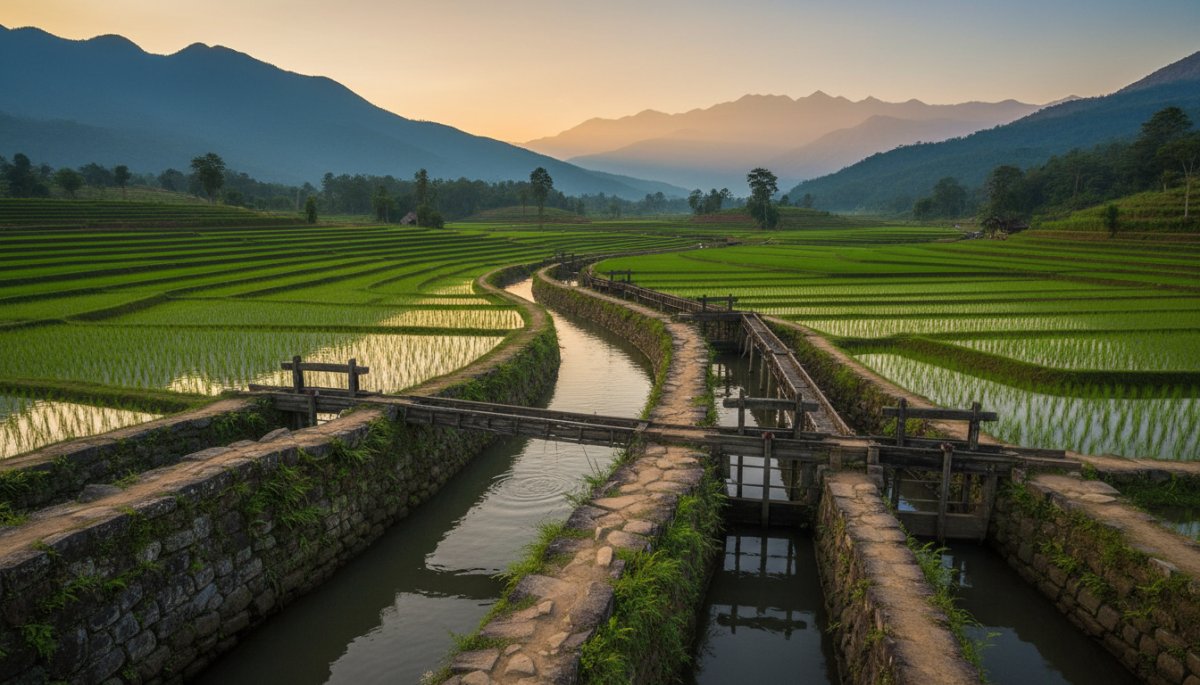
The wisdom of water management continuing from before the Common Era
In the development of Southeast Asian agriculture, irrigation technology has always played a central role.
In Sri Lanka, from the mid-5th to the mid-4th century BCE, a reservoir called Abhaya Wewa was built. Its scale, an embankment 1.5 km long and 10.5 m high, attests to the high technical level of the time. Furthermore, the Minneriya reservoir, built from the late 3rd to the early 4th century CE, boasts a huge scale, with a benefiting area of 4,670 ha and a storage capacity of 90 million cubic meters.
These facilities are still in use today, serving as models of sustainable agricultural infrastructure.
The agricultural wealth that supported Buddhist monuments
What made possible the construction of solemn Buddhist monuments, such as Indonesia's Borobudur, built at the end of the 8th century, and Thailand's Sukhothai park from the early 14th century, was the wealth brought by advanced irrigated agriculture.
It is thought that stable agricultural production through flowing-water irrigation, together with maritime trade, became the financial resources that supported these civilizations. The Sarit Phong reservoir built at Sukhothai, with an embankment 487 m long and a storage capacity of 400,000 cubic meters, still irrigates 80 ha of farmland today.
Source The Japanese Institute of Irrigation and Drainage, 'The Development Process and Outlook of Irrigation in Southeast and South Asia' prepared from
The changes in agricultural structure brought by the colonial era
The introduction of plantation agriculture
The colonial era from the 19th to the early 20th century brought major structural changes to Southeast Asian agriculture.
Vietnam's, which began in the French colonial era, coffee growing took advantage of the basalt soil of the Central Highlands, a volcanic red earth, and laid the foundation for later development. In Thailand, the Rangsit Canal was dug in the lower reaches of the Chao Phraya River at the end of the 19th century, advancing development of the central plain. This canal was used not only for irrigation and drainage but also for boat transport, enabling the development of 24,000 ha of farmland.
The shift to cash crops
Colonial rule promoted a shift from traditional self-sufficient farming to agriculture centered on cash crops.
Plantation crops such as rubber, coffee, sugarcane, and tea were introduced, and an export-oriented agricultural structure took shape. The farming pattern established in this period is the foundation of modern Southeast Asian agriculture. Malaysia's Wan Mat Saman canal, a 36 km waterway built in the latter half of the 19th century, became a pioneer of the shift from traditional farming to modern irrigated agriculture, turning Kedah into the region known as the 'rice bowl of Malaysia.'
Source The Japanese Institute of Irrigation and Drainage, 'The Development Process and Outlook of Irrigation in Southeast and South Asia' prepared from
The leap in productivity brought by the Green Revolution
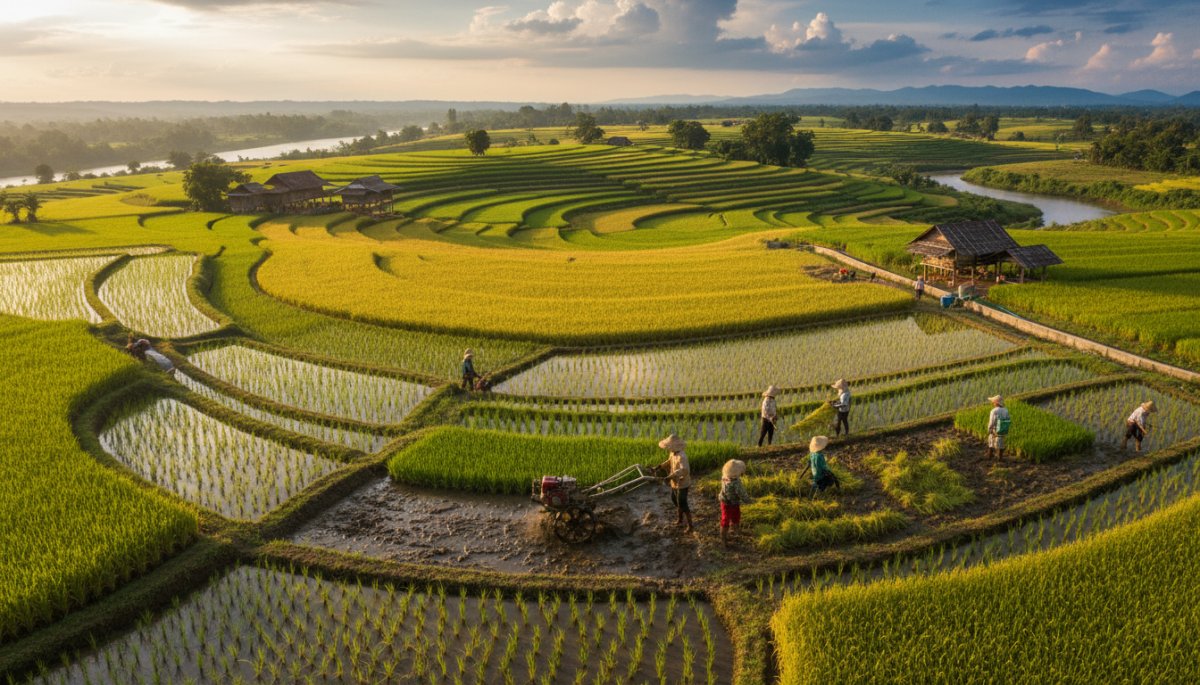
The spread of high-yield varieties
The Green Revolution of the latter half of the 20th century brought dramatic changes to Southeast Asian agriculture.
The high-yield varieties developed by the International Rice Research Institute (IRRI), based in Los Banos in the Philippines, dramatically improved rice production in this region. In particular, the development of the flood-tolerant variety 'Sub1' and salt-tolerant varieties became important technologies for responding to climate change, and they have spread widely across Vietnam, Bangladesh, India, and other areas.
The introduction of chemical fertilizers and pesticides
Along with high-yield varieties, the Green Revolution promoted the use of chemical fertilizers and pesticides.
This greatly increased output in the short term, but at the same time caused environmental problems such as soil degradation and water pollution. At present, Southeast Asian countries are seeking a shift away from excessive chemical farming, and the transition to organic and sustainable agriculture is a policy issue.
Source The Japanese Institute of Irrigation and Drainage, 'The Development Process and Outlook of Irrigation in Southeast and South Asia' prepared from
The success of market-economy reform through the Doi Moi policy
The transformation brought by granting land-use rights
Vietnam's 1986 Doi Moi policy became an important turning point in the history of Southeast Asian agriculture.
Under the earlier collective-farming system, farmers had little motivation to produce, and rice output struggled even to meet domestic demand. When Doi Moi granted land-use rights to individual farmers and introduced a market economy, agricultural production expanded dramatically. In 1989, Vietnam became a net rice exporter for the first time, and ever since it has consistently remained one of the world's leading rice export rice-exporting countries.
The establishment of agriculture as an export industry
Since Doi Moi, Vietnamese agriculture has achieved quantitative expansion.
Annual rice output is about 43.5 million tonnes and export volume is the world's second largest; coffee output is the world's second largest after Brazil, and the largest in the world for the Robusta variety; cashew nuts and black pepper rank first in the world, while shrimp ranks third in production volume and second in export volume. In 2023, total exports from agriculture, forestry, and fisheries reached about US$53 billion, accounting for more than 15% of the country's total exports.
Source Norinchukin Research Institute, 'The Growth of Southeast Asia Seen through Each Country's Agricultural Sector and Agriculture-Related Industries' prepared from
The structural challenges facing modern Southeast Asian agriculture
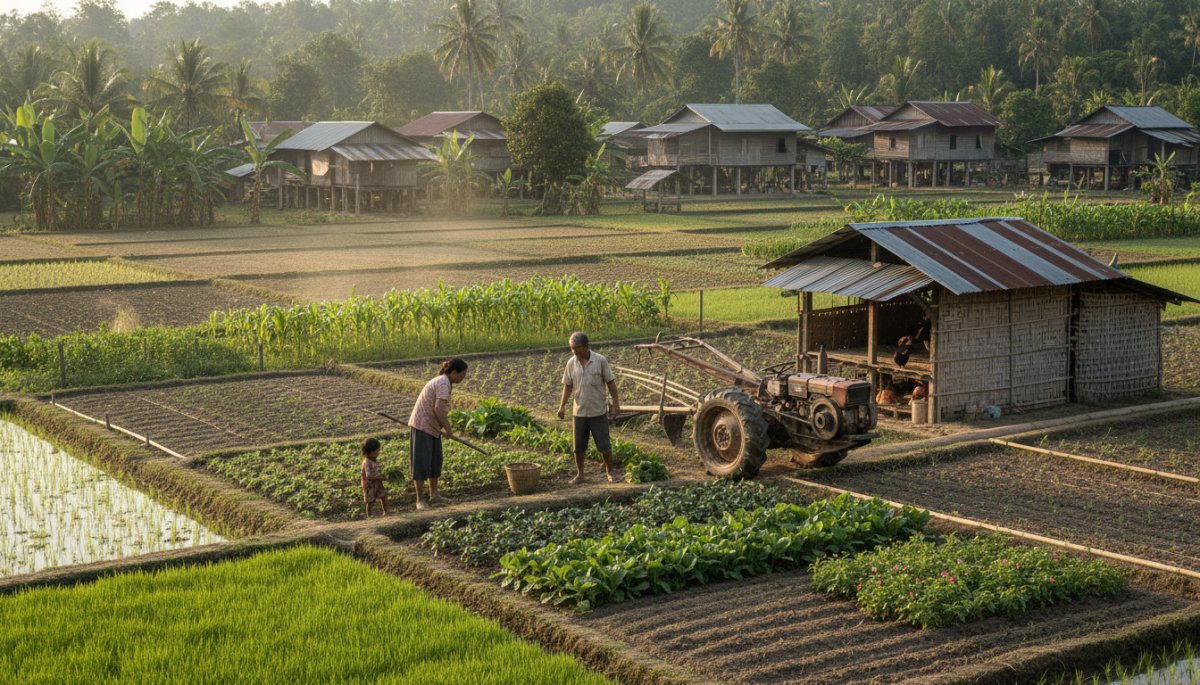
The productivity and aging of smallholder farmers
The average cultivated area per farm in Vietnam is about 0.44 hectares, among the smallest in ASEAN countries.
97% of all agricultural workers are small- and medium-scale farmers; about 57% of agricultural workers are unskilled, and the share aged 50 or older reaches about 43%. As young people continue to leave for cities, securing people to carry on farming is an urgent challenge. In Thailand, although the cultivated area per farm averages about 3 hectares, larger than in Vietnam, farmers' debt problems are growing serious.
Low Added Value and an Underdeveloped Cold Chain
One major challenge for Southeast Asian agriculture is that the bulk of agricultural exports are unprocessed primary commodities.
Taking coffee as an example, although Vietnam has the world's second-largest output, a high proportion is exported as green beans, and its brand value as roasted, processed finished products lags behind competitor countries. Furthermore, because cold chains (low-temperature logistics) are underdeveloped, there are many cases where harvested produce deteriorates and is discarded without being properly stored and transported, and post-harvest losses significantly squeeze the profitability of agriculture as a whole.
Vulnerability to Climate Change
Rising sea levels, the increasing frequency of extreme weather, and changes in rainfall patterns are directly hitting rice cultivation, which depends on low-lying delta regions.
Vietnam's Mekong Delta is one of the world's leading production areas, responsible for more than half of domestic rice output, but the risks of saltwater intrusion and flooding are increasing year by year. In the Philippines, there is a high risk of severe crop damage from nearly twenty typhoons approaching or making landfall each year on average, and as ASEAN's only net rice importer, it carries vulnerabilities in food security.
Source Norinchukin Research Institute, 'The Growth of Southeast Asia Seen through Each Country's Agricultural Sector and Agriculture-Related Industries' prepared from
Seven lessons for modern agriculture learned from history
Lesson 1: The importance of sustainable infrastructure investment
The fact that irrigation facilities dating from before the Common Era still function today shows the importance of infrastructure investment from a long-term perspective.
In modern agricultural business too, sustainable foundation-building, rather than the pursuit of short-term profit, leads to long-term success.
Lesson 2: Choosing crops that make the most of regional characteristics
Just as Vietnam's Central Highlands made the most of basalt soil suited to coffee growing made the most of the basalt soil suited to it, the key to success is making the fullest use of each region's natural conditions.
Rather than a uniform agricultural model, choosing crops suited to each region's climate, soil, and water resources is important.
Lesson 3: Boosting the motivation to produce through market-economy reform
The success of the Doi Moi policy proved the effect of respecting farmers' autonomy and making use of market mechanisms.
In modern farm management too, designing incentives for producers and securing market access are the foundation for improving productivity.
Lesson 4: Fusing technological innovation with traditional knowledge
The Green Revolution brought high-yield varieties, but at the same time caused environmental problems.
A balance between introducing the latest technology and traditional agricultural knowledge is essential for sustainable agricultural development. The flood-tolerant and salt-tolerant varieties developed by the International Rice Research Institute have spread widely as technical solutions to the modern challenge of climate change.
Lesson 5: Improving profitability through adding value
Breaking away from the structure of exporting unprocessed primary commodities is a key challenge for Southeast Asian challenges for Vietnamese agriculture of organic jasmine rice.
Primary processing techniques such as drying and powdering dramatically improve shelf life and also reduce logistics costs. Processing agricultural products and adding high value are central themes of modern agricultural business.
Lesson 6: Technology transfer through international cooperation
The "Japan-ASEAN Midori (Green) Cooperation Plan," adopted at the Japan-ASEAN Agriculture and Forestry Ministers' Meeting in May 2023, is a comprehensive cooperation framework for building sustainable agriculture and food systems in the Asian monsoon region.
Japan's technology and know-how, suited to small- and medium-scale farmers, is highly likely to fit the realities of Southeast Asia's smallholder farmers, and technology transfer through international cooperation is beneficial for both sides.
Lesson 7: A strategy for adapting to climate change
The experience of Southeast Asian agriculture, which has historically coexisted with natural disasters, suggests adaptation strategies for the climate change era.
Multi-layered risk management is required, including developing salt- and drought-tolerant varieties, improving water management techniques, and building agricultural insurance systems. Rather than a single solution, combining multiple adaptation measures makes it possible to continue farming in a highly uncertain environment.
Source Norinchukin Research Institute, 'The Growth of Southeast Asia Seen through Each Country's Agricultural Sector and Agriculture-Related Industries' prepared from
An outlook for the future: smart farming and sustainability
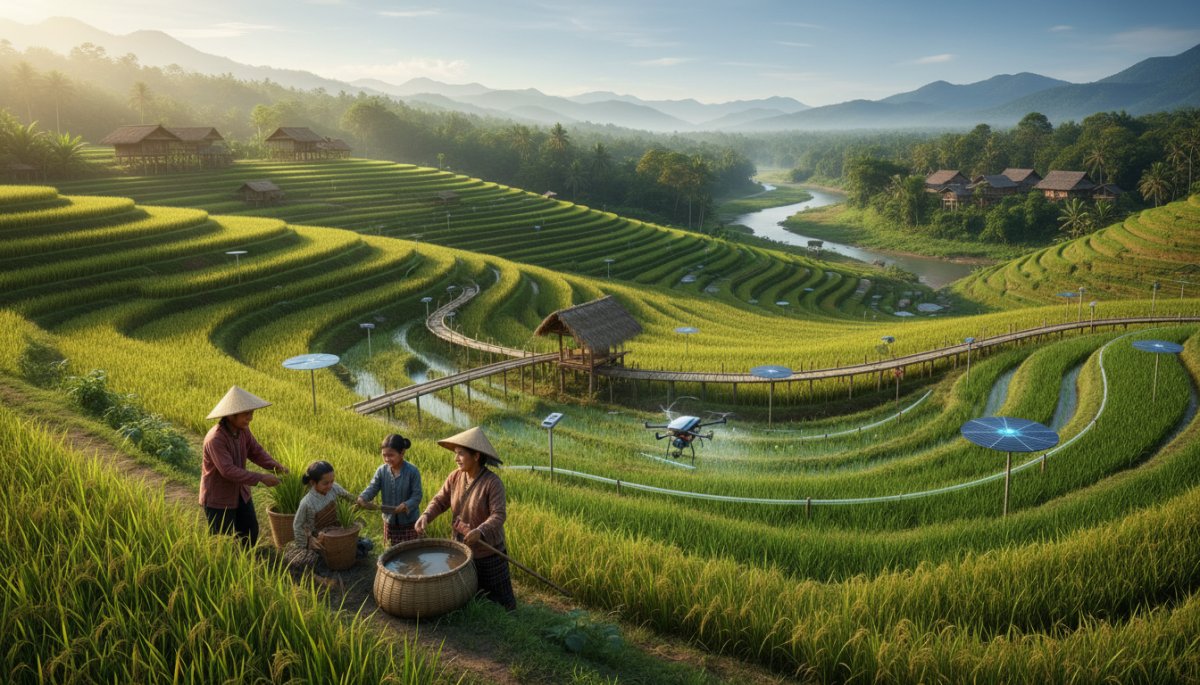
Using digital technology
The Vietnamese government has set out its "Strategy for Sustainable Agriculture and Rural Development to 2030, with a Vision to 2050," positioning the adoption of smart agriculture as a national priority.
Various technologies are being demonstrated in many places, such as environmental monitoring with IoT sensors, pesticide spraying by drone, and pest forecasting using AI. However, introducing smart farming requires initial investment, and spreading it to smallholder farmers with limited funds is the biggest bottleneck.
The shift to organic farming
The shift from conventional chemical farming to organic and sustainable agriculture is emerging as a policy issue for each country's government.
Thailand has the most developed institutional framework for organic farming in Southeast Asia, operating a certification system under the 'Thai Organic Agriculture Standard.' In Indonesia, Palm oil In response to international criticism of environmental destruction in the palm oil industry, the spread of sustainable Palm oil the spread of certification is being advanced. In Cambodia and Laos, there are moves to use organic farming as a differentiation strategy in international markets, taking advantage of the 'latecomer's advantage' that their use of chemical pesticides and fertilizers was low to begin with.
New possibilities through cooperation with Japan
Agricultural cooperation between Japan and ASEAN is entering a new phase.
Japan positions ASEAN as its most important partner for the international rollout of the environmental-impact-reducing technologies set out in its 'Strategy for Sustainable Food Systems (MIDORI).' The pillars are the transfer of precision agriculture technology, support for promoting organic farming, the introduction of paddy-field management techniques to reduce greenhouse gas emissions, and support for upgrading agricultural value chains. Japan's strength lies in having technology and know-how suited to small- and medium-scale farmers, which is considered highly likely to fit the realities of Southeast Asia's smallholder farmers.
Source Norinchukin Research Institute, 'The Growth of Southeast Asia Seen through Each Country's Agricultural Sector and Agriculture-Related Industries' prepared from
Summary: Learning from history, creating the future
The several-thousand-year history of Southeast Asian agriculture offers many suggestions for modern agricultural business.
The importance of sustainable infrastructure investment learned from ancient irrigation technology; market-oriented agriculture learned from the introduction of cash crops in the colonial era; the balance between technological innovation and environmental consideration learned from the Green Revolution; the effects of market-economy reform learned from the Doi Moi policy. These historical lessons can also be applied to solving modern challenges.
Improving smallholder productivity, improving profitability through adding value, adapting to climate change, and shifting to sustainable agriculture. For these challenges, the introduction of smart farming technology, the move to organic farming, and technology transfer through international cooperation are expected to be solutions.
Southeast Asian agriculture is now entering a period of transition from 'agricultural production' to 'agricultural economy,' and from quantity to quality. Learning from history and creating the future, in that process cooperation with the international community, including Japan, will be a key to new growth.
If you are interested in the future of Southeast Asian agriculture, please take note of the latest trends in agricultural technology and international cooperation. By applying the lessons of history to the present, let us together create a sustainable and prosperous future for agriculture.