Many people wonder, "What is happening with Myanmar's agriculture now?" When considering sourcing or importing farm produce in Southeast Asia, Myanmar is one country that cannot be ignored.
In recent years, however, drastic changes in the political situation have greatly shaken this country's agriculture. It has high potential, so why can't it show its true strength? This article explains the current state of Myanmar's agriculture from four angles: rice production, main crops, the impact of political instability, and the stalling of reform.
Basic Data on Myanmar's Agriculture
Myanmar's agriculture accounts for about 24% of GDP. About 60% of the working population is engaged in agriculture, which forms the backbone of the economy.
The country's land area is about 676,600 square kilometers. Its cultivated area reaches about 13.5 million hectares. Having vast land suited to farming is a major strength.
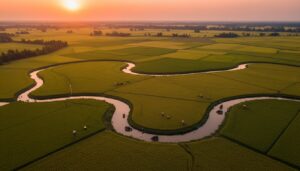
The main agricultural zone is the delta region of the Ayeyarwady River basin. Drawing on fertile soil and abundant water resources, it has long functioned as the center of rice production. Its potential as an agricultural country stands out even within Southeast Asia.
The Potential and Current State of Rice Production
Myanmar was once the world's largest rice export rice-exporting country. In the 1960s, it exported more than 2 million tonnes a year, leading the world market to that degree.
Current annual output is about 26 million tonnes. In Southeast Asia, it boasts a scale following Thailand and Vietnam.
| Country | Annual rice output (ten thousand tonnes) | Export volume (ten thousand tonnes) |
|---|---|---|
| Thailand | 3,300 | 800 |
| Vietnam | 4,300 | 700 |
| Myanmar | 2,600 | 200 |
| Cambodia | 1,000 | 300 |
Myanmar's rice is rich in varieties. "Shan State rice" in particular is characterized by its aroma and stickiness and is valued as high quality.
However, it is not fully realizing its potential. Lagging development of agricultural infrastructure and insufficient diffusion of farming technology are walls to raising productivity.
Types of Main Crops and Their Growing Regions
Beyond rice, Myanmar produces a diverse range of farm products.
Pulses and Legumes
Chickpeas, mung beans, and black-eyed peas are the mainstays, exported mainly to India and China. Annual export volume reaches about 1.5 million tonnes, occupying an important position even among agricultural exports.
Vegetables and Fruit
In Shan State and Kachin State, a variety of vegetables are grown. Tomatoes, cabbage, and potatoes are the main items. Among tropical fruits, mango, banana, and watermelon are also actively produced.
Industrial Crops
Cotton, sugarcane, and sesame are important crops as well. Sesame in particular has a long history as an export item and is exported to the Middle East and Japan too.
| Crop category | Main items | Main growing regions |
|---|---|---|
| Grains | Rice, corn | Ayeyarwady, Bago |
| Pulses | Chickpeas, mung beans | Mandalay, Sagaing |
| Fruit | Mango, banana | Mandalay, Ayeyarwady |
| Industrial Crops | Sesame, cotton | Magway, Sagaing |
The Serious Impact of Political Instability on Agriculture
Since the coup of February 2021, Myanmar's agriculture has taken a major blow. The impact is multifaceted, reaching all the way to the field level.
First, agricultural lending stalled. With the banking system in disarray, it became difficult for farmers to finance the purchase of seeds, fertilizer, and pesticides. The shortage of funds directly led to reduced production.
Next, the distribution of farm produce is stagnating. Checkpoints and road closures have raised transport costs from growing regions to markets. Wild swings in produce prices are also occurring, squeezing farmers' operations.
Furthermore, agricultural labor is in short supply. With internally displaced persons exceeding one million, securing workers in rural areas is difficult. The situation at harvest time in particular labor shortages is serious, leading to yield loss.
There is also a direct impact on agricultural exports. The value of agricultural exports in 2022 fell by about 30% year on year. Sanctions by Western countries also weigh heavily as a barrier to exports.
The Stalling of Agricultural Reform and Structural Problems
The challenges facing Myanmar's agriculture are not political instability alone. Long-standing structural problems remain unresolved.
The Land-System Problem
There are many cases where land ownership is unclear, and a situation continues in which farmers cannot invest in their farmland with peace of mind. The farmland law was revised in 2012, but implementation on the ground has not progressed.
Undeveloped Agricultural Infrastructure
The share of cultivated land with irrigation facilities in place is only about 20%. Much of the farming depends on rainfall, making it a structure easily affected by drought and flooding. Rural road development also lags, pushing up logistics costs.
Weakness in Agricultural Technology and Extension Systems
The number of agricultural extension workers is chronically insufficient. The diffusion of improved varieties and farming techniques does not progress, hindering productivity gains. Before the coup, several support programs by international organizations and NGOs were running, but most of them have now been forced to halt or scale back.
Summary
Myanmar is a country with rich agricultural potential. Centered on rice, it produces a diverse range of farm products, including pulses, fruit, and industrial crops.
However, since the 2021 coup, stalled agricultural lending, disrupted logistics, and labor shortages have worsened. Compounded by structural challenges in land systems, infrastructure, and technology extension, agricultural reform remains at a standstill.
The recovery of Myanmar's agriculture requires, first and foremost, the restoration of political stability. At the same time, land-system reform, irrigation development, and strengthening of the technology-extension system are called for. In understanding Southeast Asian agriculture as a whole, Myanmar's trajectory remains important. It is valuable to follow its changes carefully, within a comparison with neighboring countries such as Vietnam.
At VN AGRI, we share the latest information on Vietnamese agriculture.